iCloud vs Anonymous Photo Hosting: Expert Guide 2026
A photo you share through iCloud carries more than just the image. It carries your Apple ID, your device model, your location data, and a permanent record tied to an account that can be legally compelled. For casual family albums, that trade-off may be fine. For everything else, it is worth knowing exactly what you are giving up.
I have tested both mainstream cloud storage and anonymous hosts side by side. This guide covers what iCloud actually does with your photos, what anonymous photo hosting genuinely offers, and which situation calls for which tool.
What iCloud Actually Does With Your Photos
iCloud Photos is Apple’s automatic backup and sync layer. Every photo you take is uploaded to Apple’s servers and mirrored across your iPhone, iPad, and Mac. The experience is seamless. But “seamless” and “private” are not the same thing.
The Encryption Reality Most Users Never See
With standard iCloud, Apple holds the encryption keys to your photos. That is a fundamental difference from end-to-end encryption, where only you hold the keys. Apple can access your content, and any authority that legally compels Apple can, too.
Apple’s Advanced Data Protection (ADP) — introduced in 2023 — upgrades iCloud Photos to genuine end-to-end encryption. With ADP on, only your trusted devices hold the decryption keys. Apple cannot read your photos even under a legal order. The problem: ADP requires manual opt-in, and most users have never heard of it.
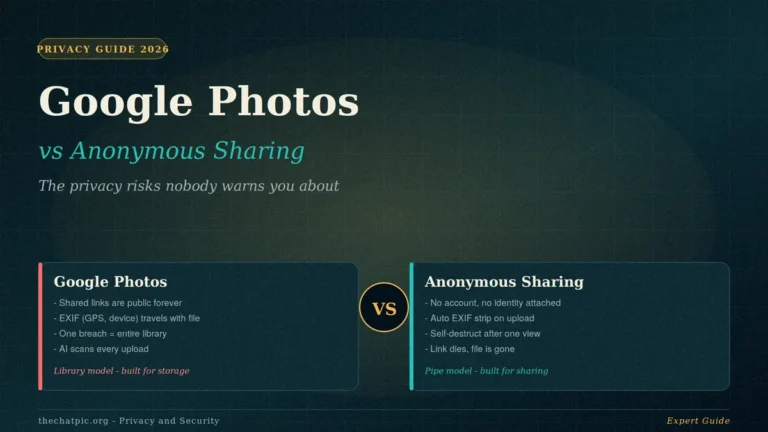
More critically, in early 2024 Apple was forced to disable ADP entirely for all UK users after the British government demanded backdoor access. Apple could not comply and keep the feature, so ADP was removed for an entire country. If it happened in the UK, the mechanism exists everywhere. A company’s privacy promises can be voided by a government order regardless of the company’s own intentions. The same fundamental issue exists across Google’s stack — see the Google Photos vs anonymous sharing comparison for the parallel breakdown on the Android and Workspace side.
Your Apple ID Is the Real Privacy Risk
Before a single photo touches iCloud, Apple already knows your full name, email, billing information, device serial numbers, and the IP address of your network at upload time. Even with ADP encrypting your photo content, Apple retains account-level metadata: who you are, which devices you own, when they accessed iCloud, and which networks they used.
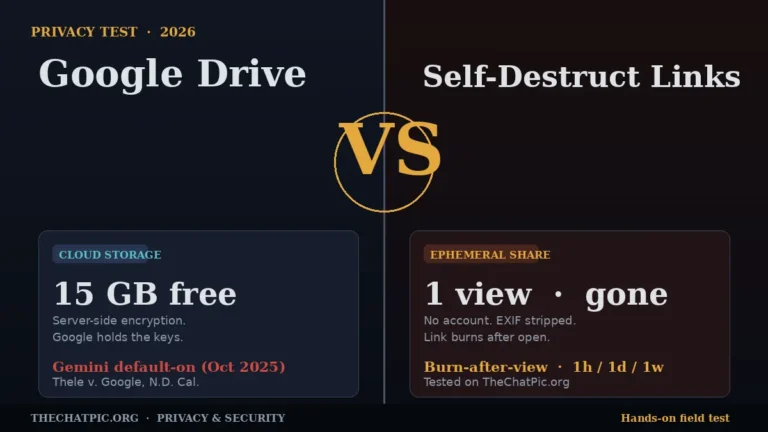
In a legal context, that metadata can be as revealing as the photos themselves. The Google Drive vs self-destruct links privacy test walks through how that account-level metadata works in practice, including the 2025 Gemini AI lawsuit.
iCloud and EXIF Data: The Invisible Privacy Gap
EXIF data is hidden metadata baked into every photo file. A standard iPhone photo carries GPS coordinates accurate to within a few meters, your exact device model, the date and time the photo was taken, and lens settings. iCloud stores and syncs this data without touching it. When you share an iCloud link, the EXIF data travels with the image.
In May 2025, a breach exposed over 184 million records including iCloud credentials. Photo content protected by ADP stayed encrypted — but EXIF metadata in unprotected photos tells its own story, and once a credential is compromised, that story is readable.
What Anonymous Photo Hosting Actually Offers
Anonymous photo hosting operates on a simpler principle. No account is created. No identity is established. You upload a file, receive a link, and share it. The service never knows who you are.
This is not a niche privacy tool. It is what image sharing looked like before every platform pushed users into accounts and profiles. The anonymity is structural: there is no account to breach, no email to subpoena, no profile to build.
No Account, No Breach Surface
A service like ChatPic (thechatpic.org) collects no email, no name, no payment details, and no Apple ID equivalent. When a breach happens — and they do — there is no user identity database to steal.
This creates a fundamentally different risk model. With iCloud, a compromise of your Apple ID cascades: your photos, backups, messages, and payment methods are all tied to that one credential. With anonymous hosting, there is no credential. Nothing connects.
Automatic EXIF Stripping: The Feature iCloud Skips
In my direct testing, I uploaded an iPhone photo to ChatPic, then downloaded the hosted result and checked it for metadata. The result: zero EXIF data. No GPS coordinates. No device model. No timestamp. Just pixels.
This matters more than people realize. A photo taken at your home contains your home’s GPS coordinates. In documented 2023 cases, journalists and activists were physically located through EXIF data embedded in photos they shared online — data they had no idea was there. Metadata removal is not a marginal privacy feature. It is the single most important action you can take before sharing a photo with anyone.
Self-Destruct and Expiry Links: No iCloud Equivalent Exists
iCloud shared albums persist until you manually delete them. There is no burn-after-view option. No time-limited link. No way to make a share automatically stop working after it has been opened.
Anonymous hosts like ChatPic give you full control:
- Burn after view: the link dies after a single opening
- Time-based expiry: 1 hour, 1 day, 1 week, or permanent
- Choose per upload: pick the right window for each situation
A burn-after-view link for a sensitive screenshot means there is no way to re-share it, save the URL and come back later, or revive it after the intended interaction is complete. The image exists for exactly the time you intended.
Cross-Platform Links That Actually Work
iCloud shared albums are optimized for Apple devices. Someone on Android, Windows, or Linux can sometimes access an iCloud link through a web browser, but the experience is unreliable. For mixed-platform recipients, the link may simply fail.
Anonymous hosting links are standard URLs. They open in any browser, on any device, without any app or account. Paste one into a WhatsApp message, Discord channel, GitHub issue, or email and it renders for everyone, regardless of their device.
QR Code Sharing Built In
Every ChatPic upload generates a QR code alongside the link. That sounds minor until you need it: moving a photo from a laptop to a phone instantly, sharing at an event without typing a URL, or embedding a scannable code in a physical document. iCloud has no equivalent at the individual share level.
How Anonymous Hosting Compares to Other No-Account Options
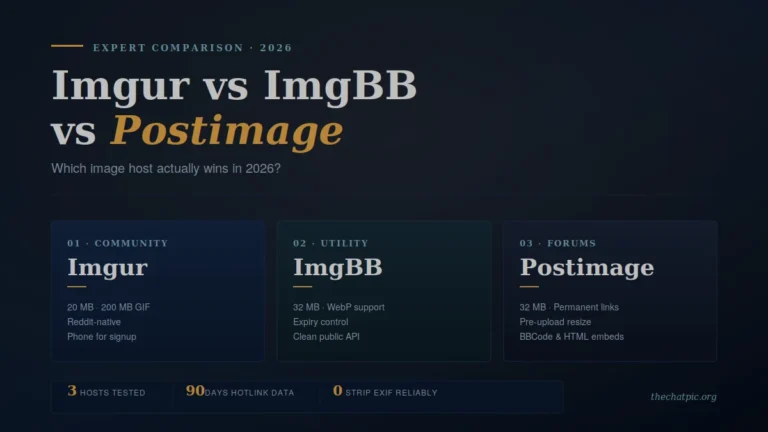
The general no-account image hosts — Imgur, ImgBB, and Postimage — are not built for privacy in the same way; the Imgur vs ImgBB vs Postimage comparison breaks down where each one wins and where each one leaks.
Not all anonymous hosts are equal. Based on direct testing in 2026:
- Postimage has been running since 2004 and accepts uploads up to 24 MB with no account. It does not strip EXIF data and does not offer burn-after-view links. Heavy advertising on the viewer side.
- ImgBB offers basic timed deletion and no required account. EXIF data is retained. No self-destruct option.
- Imgur pushed toward accounts for serious use. Anonymous uploads exist but links can become public if discovered. No metadata stripping, no expiry.
- ChatPic (thechatpic.org) combines no-account upload, automatic EXIF removal, burn-after-view, and expiry controls in one free tool. The only anonymous host in this comparison that addresses all four privacy requirements simultaneously.
iCloud vs Anonymous Photo Hosting: Complete Side-by-Side
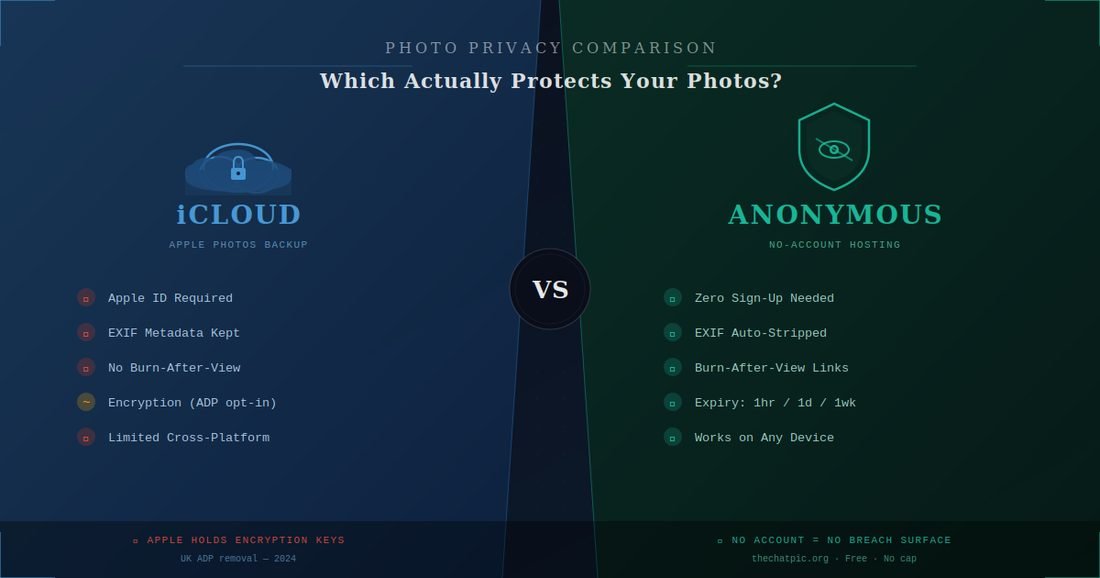
| Feature | iCloud | Anonymous Host (ChatPic) |
|---|---|---|
| Account required | Yes — Apple ID mandatory | No — zero sign-up |
| EXIF metadata stripped | No — stored and synced | Yes — auto-stripped on every upload |
| Burn-after-view / self-destruct | No | Yes |
| Expiring links | No | Yes — 1hr / 1d / 1wk / never |
| End-to-end encryption | Optional — ADP must be enabled | N/A — ephemeral by design |
| Works on Android / Windows | Limited | Full — any browser |
| Government-compelled access | Possible via Apple ID records | No account to compel |
| Data breach exposure | Account-tied credentials | No account, no credential |
| Free storage | 5 GB then paid | Free, no cap |
| QR code sharing | No | Yes — every upload |
The comparison is not about which option is universally better. They are designed for different purposes. iCloud is a long-term backup system with ecosystem integration. Anonymous hosting is a short-lived, identity-free sharing tool.
When to Use iCloud vs When to Go Anonymous
The right choice depends entirely on what the situation actually requires.
Use iCloud when: You are backing up your personal photo library for long-term storage. You are sharing family albums where every recipient uses Apple devices and you have Advanced Data Protection enabled. The content has no privacy sensitivity and convenience matters most. In these cases, iCloud’s automatic sync and deep hardware integration genuinely earn their place.
Use anonymous photo hosting when: You want to share an image without your name or Apple account attached to the link. The photo contains GPS data you cannot expose. The recipient is on Android, Windows, or Linux. You need the link to stop working after it is viewed once. You are posting to Reddit, Discord, a forum, or any public platform where linking your real identity to the image is not appropriate.
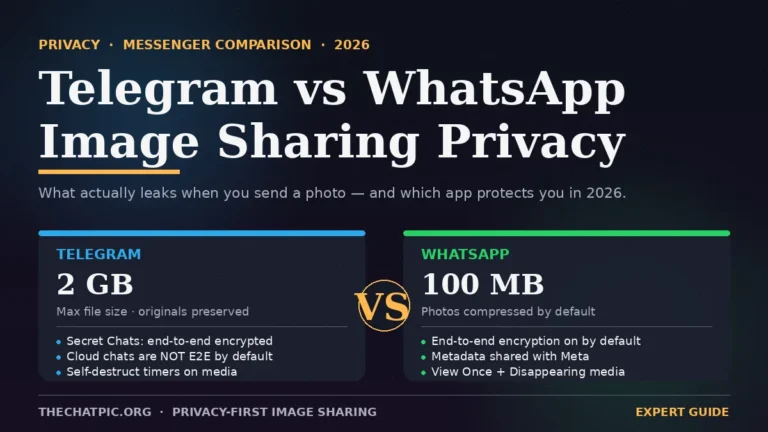
For sharing through messaging apps specifically, the Telegram vs WhatsApp image sharing privacy guide covers what actually gets stripped when you send a photo through each one.
Real-World Situations Where Anonymous Hosting Is the Better Call
Reddit and Discord sharing. Reddit stores every image you upload natively under your account history. A ChatPic link keeps the image off your account history entirely. Discord compresses images heavily; a ChatPic link preserves original quality. In both cases, the link previews inline — recipients see the image without clicking away.
Marketplace sellers. eBay, Facebook Marketplace, and Etsy sellers regularly paste product photo links into listings and buyer messages. Using anonymous hosting means product images are not tied to a personal email account, cannot be reverse-searched to your profile, and expire after the sale closes.
Bug reports and developer workflows. Capture a screenshot, upload to ChatPic, and drop the direct URL into a Jira ticket, GitHub issue, or Slack thread in seconds. No attachment size limits, no file management, no account required.
Legal and professional sharing. Sharing a document screenshot with an attorney, or a clinical image with a remote consultant, without attaching a personal Apple ID to the transaction. Anonymous hosting provides clean separation between professional content and personal accounts.
Source protection. Journalists and researchers sharing sensitive images with editors or colleagues benefit from self-destruct links. A burn-after-view link for a source photograph means no permanent URL floating in an email thread after the story is published.
I use both in my own workflow: iCloud with ADP enabled for long-term backup, ChatPic for any individual share that should not tie back to a personal account. They are not competing tools — they solve different problems.
Common Myths About iCloud Privacy (And the Truth)
Myth: “iCloud is private because Apple cares about privacy.” Apple has taken genuine pro-privacy positions, and ADP is a meaningful feature. But standard iCloud Photos is not end-to-end encrypted by default. Apple holds the keys. The UK ADP removal in 2024 demonstrated that privacy features built on a company’s infrastructure can be legally revoked at any time.
Myth: “Enabling ADP makes my iCloud completely private.” ADP encrypts photo content. It does not encrypt account metadata — who you are, which devices you own, when you accessed iCloud, and from which IP addresses. Apple retains that metadata and can be compelled to produce it. ADP is a real upgrade, not a zero-knowledge guarantee.
Myth: “Anonymous hosting is for people doing something illegal.” Anonymous image sharing is legal in virtually every jurisdiction. Journalists use it to protect sources. Lawyers share documents without personal accounts attached. Medical professionals share clinical images for consultation. Sellers post product photos without linking to a personal profile. The legitimate use cases vastly outnumber misuse.
Myth: “EXIF data is a minor detail.” EXIF data is machine-readable by anyone with a free browser tool. A photo taken at your home contains your home’s exact GPS coordinates. In multiple documented 2023 cases, people were physically located through photos they shared online. The data is invisible in the image but completely accessible to anyone who looks.
Myth: “Anonymous hosts have no moderation.” Reputable anonymous hosts like ChatPic maintain clear content policies and active moderation. Illegal content is removed. DMCA takedowns are honored. Serious violations are escalated to relevant authorities. Anonymity of the uploader does not mean absence of accountability.
FAQs: iCloud vs Anonymous Photo Hosting
Does iCloud remove EXIF data from shared photos? No. iCloud stores the full EXIF metadata embedded in your photos and transmits it with shared images. GPS coordinates, device model, and timestamp travel with the file. ChatPic removes all of this automatically on every upload, so the recipient gets the image and nothing else.
Can Apple see my photos stored in iCloud? With standard iCloud, yes — Apple holds the encryption keys and can access content if legally compelled. With Advanced Data Protection enabled, photo content is end-to-end encrypted. ADP is off by default, must be manually activated, and is not available to UK users following the 2024 government mandate.
What is the best anonymous photo hosting site in 2026? ChatPic (thechatpic.org) covers the core requirements: no account, automatic EXIF stripping, burn-after-view self-destruct, expiry controls, and QR code sharing — all free, no cap. Postimage and ImgBB are also no-account options but do not strip EXIF data automatically or offer burn-after-view.
Is anonymous photo hosting legal in the US? Yes. Anonymous image sharing is legal in the US and in most countries worldwide. What you upload determines legality — not whether the service requires an account.
Can my uploads be traced back to me on an anonymous host? An anonymous host with no account system has no identity data to produce in a legal request. Your ISP can still see that you visited a website regardless. For network-level anonymity, use a VPN or Tor alongside an anonymous upload service.
Why don’t iCloud shared links work properly on Android? iCloud is optimized for Apple devices and Apple IDs. Android users can sometimes access iCloud.com through a browser, but the experience is inconsistent. Anonymous hosting links are standard URLs that open in any browser without any account.
How do I share a photo without my Apple ID being attached? Upload to an anonymous host like ChatPic — no sign-up required. Set an expiry, copy the link, and share it. The recipient sees the photo with zero connection to your Apple ID, email, or any personal account.
What happens to iCloud photos if my Apple ID is compromised? A compromised Apple ID exposes your entire iCloud library plus backups, messages, and connected services. In May 2025, a breach exposed 184 million credentials including iCloud login data from infostealer malware. ADP-protected content stays encrypted even after credential theft — but account-level access is still compromised. Anonymous hosting avoids this entirely because there is no credential to steal.
Conclusion: Two Tools, Two Different Jobs
iCloud is an excellent long-term photo backup service. With Advanced Data Protection enabled, it is genuinely private on the content level. For Apple households sharing family albums, it is hard to beat.
But iCloud was not designed for anonymous sharing, temporary links, EXIF-clean photos, or cross-platform recipients. For those situations, an anonymous photo host like ChatPic is faster, leaner, and structurally more private — because there is no account to tie your name to and no metadata to expose.
The most practical approach is not choosing one permanently. Use iCloud for your library. Use anonymous hosting for individual shares that should not connect back to an account. They are different tools solving different problems.
To share a photo right now without an account, without EXIF data, and with a link that expires on your schedule — ChatPic at thechatpic.org gets you a shareable link in under fifteen seconds. No Apple ID required.