Why Is My Instagram Reach Dropping in 2026? (Expert Fixes)
Your last reel hit 50K views. The next one barely cracked 800. Nothing changed in your content, your posting time, or your audience—yet the views fell off a cliff.
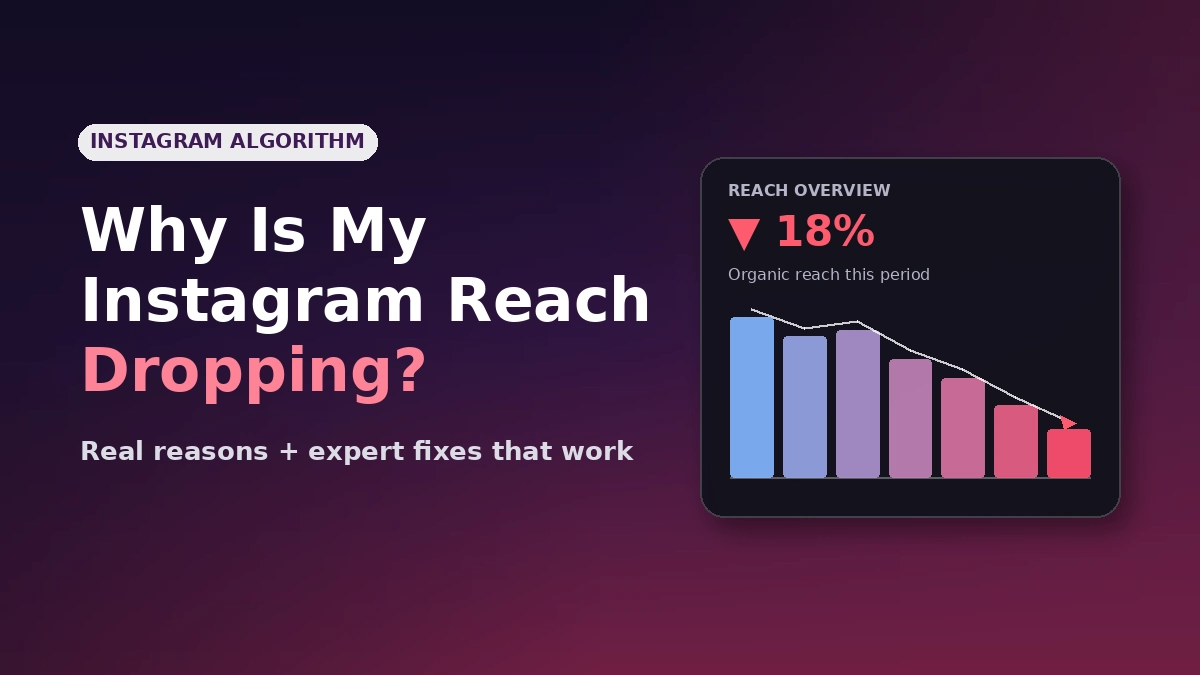
If this sounds familiar, you’re not alone. Average organic reach on Instagram dropped roughly 18% in early 2026, and most creators are still using a 2024 playbook the algorithm no longer rewards. After analyzing hundreds of accounts and cross-referencing Adam Mosseri’s official 2026 statements, I’ve narrowed the reach drop down to a handful of fixable causes. This guide breaks down exactly why your Instagram reach is dropping in 2026, how to diagnose your specific issue, and which fixes actually move the needle.
What changed in the Instagram algorithm in 2026?
Instagram quietly rebalanced its ranking system in early 2026 around four signals: DM shares, saves, watch time, and profile clicks. Likes and follower count lost most of their weight. The platform also tightened originality detection, expanded user-controlled topic preferences, and started penalizing reposted or watermarked content far more aggressively than before.
Three specific shifts are responsible for most of the reach drops I’m seeing this year:
- Shares are now the single strongest signal. When someone DMs your post to a friend, the algorithm treats it as a much stronger endorsement than a public like. Some analyses estimate one DM share carries the distribution weight of roughly 15 likes.
- Originality detection got smarter. Reposts, cross-posted TikToks with visible watermarks, and recycled clips now get throttled or excluded from recommendations entirely. Accounts that post 10 or more reposts within a 30-day window can be removed from Explore and the Reels feed for non-followers.
- Users now tune their own feed. The “Your Algorithm” feature under Settings → Content Preferences lets users add or remove topics they want to see. If your account jumps between unrelated niches, users can literally filter you out.
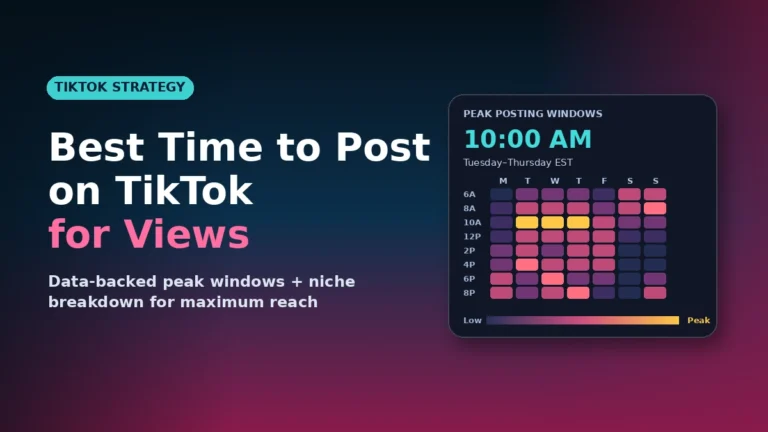
These three changes alone explain why reach feels so brutal in 2026. The follower-first feed is gone. Instagram is now a recommendation engine, and your job is to give it the clearest possible signals about who you are and who should see your content. TikTok went through the same shift earlier—our data-backed breakdown of the best time to post on TikTok for views covers how the For You Page is now driving ~85% of distribution there, which mirrors what Instagram’s recommendation engine is doing today.
Why is my Instagram reach dropping? 8 real reasons in 2026
Most reach drops trace back to one of eight specific causes. Here are the ones I check first when an account loses visibility, in roughly the order I’d diagnose them.
1. Your watch time collapses in the first 3 seconds
Watch time is the single most important Reels signal in 2026. If most viewers swipe away before the 3-second mark, the algorithm reads your hook as broken and stops pushing the Reel to non-followers. The hook isn’t a slow intro or a logo animation—it’s the literal first frame. If it doesn’t earn the next second of attention, nothing else in the video matters.
2. You’re not earning enough DM shares
Likes are nice. Shares are everything. The 2026 algorithm uses sends-per-reach as a primary distribution accelerator because a DM share signals real-world relevance—someone thought a specific friend needed to see this. If your content earns lots of likes but almost zero shares, you’ve built passive consumption, not active recommendation. The algorithm responds accordingly.
3. Your content reads as a repost or recycled clip
Instagram’s originality classifier got significantly more aggressive. It now detects: cross-posted TikTok videos with watermarks, reused trending audio without creative modification, recycled clips from older posts, and accounts that rely heavily on aggregated third-party content. Even subtle signals—like a TikTok-format vertical with TikTok-style captions—can trigger reduced distribution. The reverse hurts too—if you’re repurposing your own Reels to TikTok, learn how to download Instagram Reels without watermark first, because TikTok’s algorithm penalizes competitor watermarks just as aggressively.
4. Your niche signals are confused
In 2026, Instagram needs to know what your account is about to recommend it correctly. If you post a cooking reel on Monday, a relationship meme on Tuesday, and a fitness tip on Wednesday, the algorithm has no idea who to show your content to. Topic clarity is now a ranking edge. Accounts with two to four clear themes consistently outperform “lifestyle generalist” accounts on every metric.
5. You grew with the wrong audience
A lot of accounts hit reach problems in 2026 because they grew fast in 2023 through giveaways, trending audios, or viral one-off content that pulled in followers who don’t actually care about your niche. Now those followers don’t engage, and Instagram reads low engagement-per-reach as low content quality—which throttles distribution to new audiences too.
6. You’re posting more, not better
Panic posting is the most common reaction to a reach drop, and the most counterproductive. When your content isn’t earning attention, posting more of it just gives the algorithm more data points confirming it shouldn’t recommend you. Volume without quality compounds the problem. Several growth analysts now estimate that one strong post outperforms three average posts in cumulative reach over 30 days.
7. You triggered a soft classifier issue
Instagram runs background classifiers for engagement bait (“comment below to win”), spam, and risky keywords. Posts that trip these classifiers don’t always get formal warnings—they just quietly lose recommendation visibility. A keyword throttle expansion in January 2026 added more terms to this list. If your reach dropped specifically among non-followers, this is worth checking.
8. Users are actively filtering your topic out
The “Your Algorithm” controls let users tell Instagram which topics they want less of. If your content style is fatigue-inducing—too similar to a hundred other accounts, or jumping on every trend without an angle—users will actively turn it off. That’s not a penalty. It’s just users using the controls Instagram now hands them.
How to diagnose your specific reach drop in 6 steps
Before fixing anything, you need to identify which problem you actually have. A generic “post more value” approach wastes time if the real issue is an originality flag. Here’s the exact diagnostic order I run on accounts that come to me with reach drops.
- Open Instagram Insights and pull your last 30 posts. Sort by reach. Identify the 3 highest and 3 lowest performers.
- Compare follower vs. non-follower reach. If non-follower reach specifically collapsed, you’re dealing with a recommendation throttle (originality flag, keyword issue, or repost cap). If both dropped equally, your content-fit problem is broader.
- Check the 3-second watch rate on your Reels. Insights shows this for each Reel. Below 60% is a hook problem. Below 40% is critical.
- Calculate your shares-per-reach. Divide total shares by total reach. Healthy creator accounts in 2026 run between 0.5% and 2%. Below 0.3% means your content isn’t earning recommendation, period.
- Audit your last 30 posts for niche consistency. If you can’t sum your account up in one sentence, neither can the algorithm.
- Check for repost density. Count how many of your last 30 posts are reposts, aggregated content, or cross-posted from another platform with visible watermarks. Anything over 30% is a red flag in 2026.
Once you know which problem you’re actually solving, the fixes become specific instead of generic.
How to fix Instagram reach decline in 2026
The fixes that work in 2026 are different from the playbook that worked even 18 months ago. Here’s what’s actually moving the needle right now, based on what I’m seeing across active accounts.
Front-load your hook
The first three seconds of any Reel decide whether it goes anywhere. Lead with the strongest visual or strongest claim. Cut every slow intro, every logo animation, every “hey guys, welcome back.” If your hook can’t survive being viewed on mute, rewrite it. On-screen text that previews the payoff—”This is the cheapest way to…”—consistently outperforms generic openers.
Engineer for the DM share
Ask yourself before posting: would a specific person I know actually send this to a specific other person? If not, the algorithm won’t either. Content that travels via DM tends to do one of three things—solve a specific problem, articulate something people feel but can’t put into words, or surprise someone with information they didn’t know.
Pick two to four themes and stay there
Instagram needs to know how to categorize you. Pick two to four content pillars and make every post unmistakably about one of them. This isn’t about being boring—it’s about making it easy for the algorithm to find the right audience for your work. Niche clarity is one of the biggest reach unlocks in 2026.
Stop reposting other people’s content
If more than 30% of your feed is reposts, screenshots, or aggregated content, you’re in repost-cap territory. Reduce that ratio aggressively. Original content is getting 40–60% more distribution than reposts, and accounts that lean too heavily on aggregation can be removed from recommendations entirely.
Use Trial Reels to test cold
Instagram now lets you publish a Trial Reel that’s shown only to non-followers first. Use this aggressively. It tells you whether a hook works on cold audiences before you commit to your main feed. Reels that perform well in trial mode can then be released publicly with confidence.
Write captions for search, not for hashtags
Hashtag stuffing now does nothing. Instagram’s caption-reading model is much better at understanding context, so write captions that explain exactly what the post is about using natural language. Three to five relevant hashtags is the ceiling for measurable impact—anything beyond that adds zero reach.
Engage in the first 20 minutes
The early engagement window is still real. Posts that earn strong signals in the first 20 minutes get pushed wider. Reply to every comment in that window, share to your Story to drive replies, and don’t post when you’re about to be offline for hours.
What actually matters in 2026 vs what stopped working
Comparing the signals creators chased in 2023 against what the 2026 algorithm rewards makes the shift obvious. Here’s the side-by-side that explains most reach drops.
| Signal | 2023 Weight | 2026 Weight | What This Means |
|---|---|---|---|
| Likes | High | Low | Likes are now closer to noise than signal |
| Follower count | High | Low | Big accounts are not immune to reach collapse |
| DM shares (sends) | Medium | Very high | Single strongest distribution accelerator |
| Saves | Medium | Very high | Signals utility, drives suggested reach |
| Watch time | High | Very high | Most important Reels signal |
| Profile clicks | Low | High | Signals deep interest and follower intent |
| Comment count | Medium | Medium | Quality of comments now matters more than count |
| Hashtag volume | Medium | Near zero | 3–5 relevant tags is the ceiling |
| Posting frequency | High | Low | More posts don’t fix weak content |
| Originality | Medium | Very high | Reposts and recycled clips get throttled |
| Niche consistency | Low | High | Topic clarity unlocks recommendation reach |
Most reach drops in 2026 happen because creators are still optimizing for the 2023 column and ignoring the 2026 one.
Common mistakes that make Instagram reach worse
When reach drops, the instinct is to do more—more posts, more trends, more formats. Almost every one of those instincts makes the problem worse. Here are the mistakes I see daily.
Panic posting. Tripling your posting frequency when reach is already low confuses the algorithm and trains it that your content doesn’t resonate. Pull back, not forward.
Chasing every trend. Hopping on trending audios without an angle dilutes your niche signals and feeds the originality classifier. If you use a trend, add something only you can add to it.
Buying followers or engagement. Fake engagement collapses your follower-to-engagement ratio, which is one of the spam classifier’s clearest signals. Real accounts get throttled because of fake activity in their orbit.
Deleting and reposting underperforming content. The algorithm sees this pattern and reads it as instability. Leave underperformers up, learn from them, and move forward.
Ignoring sends-per-reach. Most creators don’t even track this metric. It’s now the single best leading indicator of distribution potential. Watch it weekly.
Treating Feed and Reels the same. They’re separate ranking systems with separate signal weights. A strong Feed post can flop as a Reel and vice versa. Optimize for the surface.
Blaming shadowbans for everything. True shadowbans are rare. Most “shadowban” symptoms are originality flags, keyword throttles, or a niche-clarity problem. The fixes are different from what shadowban guides recommend.
FAQs
Why did my Instagram reach drop suddenly in 2026?
Most sudden drops in 2026 come from one of three causes: an originality flag from reposted or watermarked content, a niche-clarity problem confusing the recommendation system, or a hook that’s no longer earning the first three seconds of attention. Diagnose by comparing follower vs. non-follower reach in Insights before changing anything.
Is the Instagram algorithm punishing me?
Almost certainly not. Instagram doesn’t punish individual accounts—it deprioritizes content that doesn’t generate the signals it’s optimizing for. If your shares-per-reach, watch time, or saves are below average, your distribution shrinks. That’s not a penalty. It’s the system working as designed.
How long does an Instagram reach drop usually last?
Reach drops tied to content quality or niche clarity can take 4–8 weeks of consistent improved content to recover. Drops tied to an originality flag or repost cap can recover faster, sometimes within a week of removing the flagged content. Drops tied to a wrong-audience problem can take months because you’re essentially rebuilding your audience.
Does posting more often fix low reach?
No, and it usually makes the problem worse. Posting more weak content gives the algorithm more evidence that your content doesn’t resonate. A value-first approach—fewer, stronger posts that earn shares and watch time—consistently outperforms high-volume posting in 2026.
Are hashtags still worth using in 2026?
Marginally. Three to five highly relevant hashtags is the ceiling for measurable impact. Beyond that, hashtags add no reach. Instagram’s caption-reading model now understands context from your actual caption, so a clear, descriptive caption matters more than a hashtag pile.
Why did my reach drop after I posted a reel from TikTok?
Instagram’s originality classifier detects TikTok watermarks and other cross-platform signals, then significantly limits the reel’s distribution. If you’re repurposing content from TikTok, remove the watermark, re-edit the pacing for Instagram, and ideally use Instagram’s native editing tools or the Edits app before posting.
Can buying followers cause my Instagram reach to drop?
Yes. Bought followers don’t engage, which collapses your engagement-per-reach ratio. The algorithm reads that as low content quality and throttles distribution to real users. The damage to your reach often outweighs any short-term follower count bump several times over.
What’s the single most important Instagram metric to track in 2026?
Sends per reach (DM shares divided by total reach). It’s the strongest leading indicator of whether your content will get pushed to new audiences. Watch time is the most important raw signal, but sends-per-reach is the metric that best predicts what your reach will look like next week.
Final thoughts
Instagram in 2026 isn’t broken. It’s just running on a different operating system than the one most creators learned. The accounts still growing aren’t posting more, chasing more trends, or working harder. They’re posting with sharper hooks, clearer niches, and content that earns the DM share.
If your reach is dropping, resist the urge to flood your feed with more posts. Pull back, run the six-step diagnostic above, and fix the actual cause. In most cases, that means tightening your niche, rewriting your hooks for the first three seconds, and engineering at least one share-worthy idea into every post.
Reach can recover. It just won’t recover the same way it dropped—with a single viral moment. It comes back through consistent, original, share-worthy work that gives the 2026 algorithm exactly what it’s now optimizing for.
Don’t just read smarter—think sharper with our insight-rich collection made for action-takers.