Best Time to Post on TikTok for Views: Expert Guide
Two creators post the same quality video. One gets 200 views. The other hits 80,000. The only meaningful difference? When they hit publish.
After analyzing data from over 7 million TikTok posts (Buffer), nearly 2 billion engagements across 307,000 profiles (Sprout Social), and dozens of niche-level studies, the patterns are clearer than most creators realize. This guide breaks down the best time to post on TikTok for views, exactly which days outperform others, why timing matters more than it used to in 2026, and how to find the windows that actually work for your specific account.
What’s the best time to post on TikTok for maximum views?
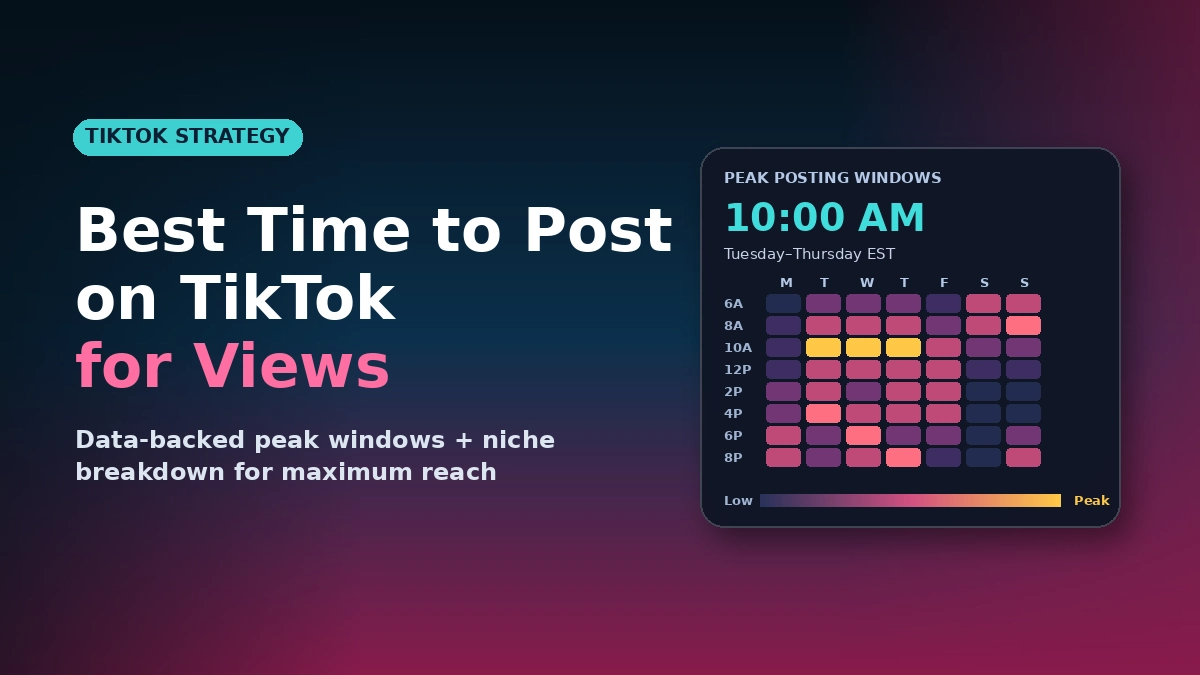
The best time to post on TikTok for views is generally Tuesday through Thursday between 10–11 AM EST, with strong secondary windows from 6–10 AM and 7–11 PM. Posting 30–60 minutes before your audience’s peak activity gives the algorithm time to complete its initial test batch right when your viewers start scrolling.
Three quick facts that explain the entire posting-time playbook:
- The first 60 minutes decide roughly 80% of a video’s success. TikTok tests your content with a small batch of 200–500 viewers, then expands distribution based on early signals.
- Your follower graph only drives about 15% of your distribution. The other 85% comes from the For You Page, which runs on global attention patterns—not just your specific audience.
- Timing alone won’t save a weak video. A great hook posted at a mediocre time still beats a mediocre hook posted at a perfect time. Timing moves you from the 50th to the 60th percentile of a video’s potential. The hook moves you from the 60th to the 99th.
Use the day-by-day breakdown below as your starting map, then refine it with your own analytics over a few weeks.
Best times to post on TikTok by day of the week
Engagement on TikTok follows predictable weekly rhythms. Midweek mornings and late afternoons dominate, weekends underperform on average, and Sunday evenings are an algorithmic dead zone. Here’s the day-by-day breakdown based on the largest 2026 datasets.
| Day | Peak Posting Windows (EST) | Why It Works |
|---|---|---|
| Monday | 1–3 PM, 7–9 PM | Users decompressing from Monday workload; light scrolling spike after work |
| Tuesday | 9–11 AM, 4–6 PM | Strongest day overall; morning scroll + late-afternoon slump |
| Wednesday | 9–11 AM, 7–8 PM | Midweek peak engagement; users firmly settled into platform habits |
| Thursday | 10 AM–12 PM, 7–9 PM | High-velocity day; consistently top performer for B2C creators |
| Friday | 10 AM–12 PM, 2–5 PM | Pre-weekend wind-down; engagement drops after 6 PM as users go offline |
| Saturday | 9–11 AM only | Weekend morning slow-scroll; avoid posting after noon |
| Sunday | 8–10 AM, 7–9 PM | Strong morning slot for relaxed scrolling; evening window is hit-or-miss |
The most reliable single time slot across studies is Tuesday at 10 AM EST. The highest-engagement single hour Buffer identified across 7.1 million posts is Sunday at 9 AM, when users are in slow-scroll mode and weekly competition is lower.
If your audience is split across US time zones, post once at 6 PM EST to catch East Coast viewers and again around 9 PM EST to bring in West Coast users still settling into their evening scroll.
Why timing matters more on TikTok in 2026
The TikTok algorithm rewrote its distribution math in 2026, and timing now affects reach more than it did even 18 months ago. Three changes are responsible.
The first 60 minutes carry 80% of your distribution weight
TikTok serves new videos to a test batch of 200–500 users immediately after publish. If those viewers watch, save, share, or rewatch, the algorithm pushes the video to a wider audience. If they scroll past, the distribution ramp dies in the first hour. Posting when your audience is actually active dramatically improves the early signals the algorithm reads.
“Qualified views” raised the quality bar
A view in 2026 only counts as qualified if it lasts longer than five seconds. The completion rate threshold for viral distribution sits around 70%—up from roughly 50% just a couple of years ago. Videos that fail to earn enough qualified views get stuck in what creators call “200-view jail,” where they never escape the initial test batch. Posting at a strong time means more of your test batch is paying attention, which means more qualified views.
The follower graph shrunk to ~15% of distribution
This is the biggest shift most creators haven’t internalized. The For You Page handles roughly 85% of TikTok distribution, and the FYP runs on global attention windows—not your specific audience’s habits. Instagram’s algorithm went through a similar rebalancing this year too—if you cross-post, the patterns behind Instagram reach dropping in 2026 are worth knowing because the same signals (DM shares, saves, watch time) now drive distribution on both platforms. This is why some videos perform better at “weird” times like Monday 1 AM ET (which is Monday 11:30 AM in India and Monday 8 AM in Europe). Optimizing only for your local audience’s window optimizes for the minority of your potential reach.
The practical takeaway: post when your immediate audience is most active (for early signals), but understand that your real distribution upside comes from matching global attention rhythms too.
How to find your personal best time to post on TikTok
Generic data is a starting point. Your specific best time depends on your niche, your audience’s location, and your content style. Here’s the exact three-step audit I run to find a personalized posting schedule.
Step 1: Pull your audience’s most active times from TikTok Studio
- Open the TikTok app and go to your profile.
- Tap TikTok Studio (under your bio).
- Tap the Analytics card and open View all.
- Choose the Followers tab.
- Scroll to Most active times.
You’ll see a heatmap showing when your followers are on the app over the past seven days. Note your top three hourly windows. This is the foundation, not the full answer.
Step 2: Audit your top 10 highest-view videos from the last 60 days
Open TikTok Studio Analytics again and sort your recent videos by views. For each of your top 10, write down the publish day and hour. Look for patterns—you’ll often find that your best videos cluster around two or three specific windows that may differ from your followers’ “most active” times. This happens because the FYP distributes your work to non-followers whose habits don’t match your follower base.
Step 3: Subtract 30–60 minutes from your peak windows
The single biggest mistake creators make is posting during their audience’s peak rather than before it. The TikTok algorithm needs time to finish its test batch before distribution ramps up. If your audience peaks at 7 PM, post around 6:00–6:30 PM. The test batch completes during the early ramp, and your video hits the FYP with full momentum exactly when your viewers are scrolling.
Stick to your tested schedule for three to four weeks before changing it. Algorithms shift constantly, but you need enough data to separate signal from noise.
Best posting times by content type and niche
Timing patterns also shift based on what you create. Here’s how the strongest windows break down across the most common TikTok niches.
| Niche | Strongest Window (EST) | Reason |
|---|---|---|
| Fitness & wellness | Mon–Wed, 6–8 AM | Users are motivation-priming during morning routines |
| Food & recipes | Sun 11 AM, Tue–Thu 4–6 PM | Pre-meal scrolling and dinner inspiration windows |
| Education & how-to | Tue–Thu 10 AM–12 PM | Peak focus hours when users seek practical content |
| Finance & business | Tue–Thu 7–9 AM, 12–1 PM | Pre-market and lunch-break professional scrolling |
| Beauty & fashion | Wed–Fri 7–10 PM | Evening browsing and “tomorrow’s outfit” inspiration |
| Comedy & entertainment | Thu–Sat 8–11 PM | Pure leisure-time engagement; high share rates |
| Travel | Sun 8 AM, Fri 4–6 PM | Weekend daydream scrolling and weekend trip planning |
| Gaming | Fri–Sun 7–11 PM | Aligns with prime gaming hours; high comment density |
| Parenting | Tue–Thu 8–10 PM | Post-bedtime scrolling for parents catching a break |
| B2B & marketing | Tue–Thu 11 AM, 4–5 PM | Lunch breaks and end-of-workday decompression |
These windows are starting points calibrated against 2026 niche benchmarks. Test against your own analytics and adjust by 30–60 minutes earlier than your peak window to give the algorithm a head start.
Common TikTok timing mistakes that kill your views
Most posting-time problems aren’t about picking the wrong hour. They’re about repeating the same handful of strategic errors. Here’s what to fix first.
Posting during peak instead of before peak. Hitting publish exactly when your audience is most active means the algorithm hasn’t finished its test batch yet, and the distribution ramp starts late. Move every publish time 30–60 minutes earlier.
Posting at random times. The TikTok algorithm rewards consistency. Random publish times train the platform that your account is unpredictable, which weakens its ability to test and distribute your work efficiently. Even a rough weekly schedule outperforms ad-hoc posting.
Over-posting because views are low. Posting 14 mediocre videos in a week underperforms 4–5 great videos posted at peak windows. Buffer’s analysis of 11.4 million posts shows clear diminishing returns after 5 posts per week. Volume can’t fix a hook problem.
Ignoring your highest-performing video’s publish time. Most creators look at their best video, celebrate, and move on. The far more useful move is to write down the exact day and hour it went live, then test that same window with your next three videos.
Confusing follower activity with FYP distribution. The “Most Active Times” graph in TikTok Studio shows when your existing followers are online—not when the FYP will distribute your video to new audiences. Your viral upside lives in the gap between the two.
Cross-posting Reels with the Instagram watermark still attached. TikTok’s originality classifier de-prioritizes content with competing-platform watermarks, which can cap your reach no matter how well you time the post. If you’re repurposing Reels, learn how to download Instagram Reels without watermark first so the file you upload reads as native to the algorithm.
Posting and disappearing. The first 60 minutes are critical. If you post and immediately close the app, you miss the chance to reply to early comments, which is one of the strongest engagement-velocity signals available. Be available for the first hour after every post.
Treating weekends as universally weak. Saturday afternoons and Sunday evenings underperform, but Saturday mornings (especially 7–9 AM EST) consistently rank among the top single-time-slot performers in 2026 datasets because competition drops while user attention stays steady.
FAQs
What’s the single best time to post on TikTok for views?
Based on the largest 2026 datasets, Tuesday at 10 AM EST is the most reliable weekday peak. Sunday at 9 AM EST is the highest single-hour performer when accounting for slower-scroll behavior and lower competition. Both work well as starting points, but your personalized best time depends on your niche and audience location.
How often should I post on TikTok in 2026?
Two to five posts per week delivers the best view lift per post, based on Buffer’s analysis of 11.4 million TikTok posts. Posting more than five times weekly produces diminishing returns. Consistency matters more than volume—posting three times every week beats posting seven times one week and zero the next.
Does posting time actually affect TikTok views?
Yes, but less than content quality does. Strong timing typically improves a video’s performance by 10–15%, while a strong hook can change performance by 5–10x. Timing matters most for borderline-good videos that need extra algorithmic momentum. Great content performs reasonably well even at off-peak hours.
Should I post when my followers are most active?
Post about 30–60 minutes before your followers’ peak activity window. The TikTok algorithm needs time to complete its initial test batch before pushing the video out widely. Posting exactly during peak hours means distribution ramps up after the peak has already started fading.
What time should I avoid posting on TikTok?
Avoid Saturday afternoons (12–6 PM EST), Sunday evenings after 7 PM, and weekday late-night hours from 12–4 AM EST. These windows show the lowest engagement velocity in 2026 data because users either scroll less or compete with high content volume from off-schedule creators.
Do I need to post at the exact same time every day?
No, but you do need consistent posting days. The algorithm rewards predictable activity at the account level. Posting Tuesday-Thursday-Saturday every week trains TikTok that your account is reliable. The exact hour can shift by 1–2 hours without hurting performance.
Does TikTok still favor newer accounts in posting time analysis?
Slightly. New accounts get a small “exploration boost” during their first 30 days where the algorithm tests them more aggressively across non-follower audiences. This makes timing less critical early on. Once an account is established, peak-window posting starts mattering significantly more.
How long does TikTok take to fully distribute a video?
Up to 24 hours, though most distribution happens in the first 60 minutes. The algorithm tests your content with a small batch immediately, then gradually expands distribution if engagement signals are strong. Videos can also resurface days or weeks later if they continue earning saves and shares.
Final thoughts
The best time to post on TikTok for views isn’t a single magic hour—it’s a system. Pick your weekly peak windows from the data above, subtract 30–60 minutes to give the algorithm runway, post consistently for three to four weeks, then check your TikTok Studio analytics and refine.
Most creators obsess over timing because it feels more controllable than the algorithm itself. But the truth is brutal and freeing at the same time: a great hook posted at a mediocre time still outperforms a mediocre video posted at the perfect time. Use timing to get your good work to the right audience faster. Don’t use it to rescue weak content.
Pick two to three peak windows for the next week, schedule your strongest videos against them, and treat the next month as a controlled experiment. The data you’ll gather about your own account is worth more than any aggregate study—including this one.
Make every minute count—explore distraction-free content built for deep understanding.