Tools to Compress PDF Without Losing Quality: Expert Picks
The best tools to compress PDF without losing quality in 2026 are Adobe Acrobat (gold standard, paid), Smallpdf and iLovePDF (free online with quality levels), PDFgear (free offline desktop, no watermarks), Preview on Mac (built-in), and Ghostscript (free command-line for power users). The right pick depends on one question — is your document sensitive enough that you should keep it off third-party servers? If yes, go offline. If no, the free online tools work beautifully.
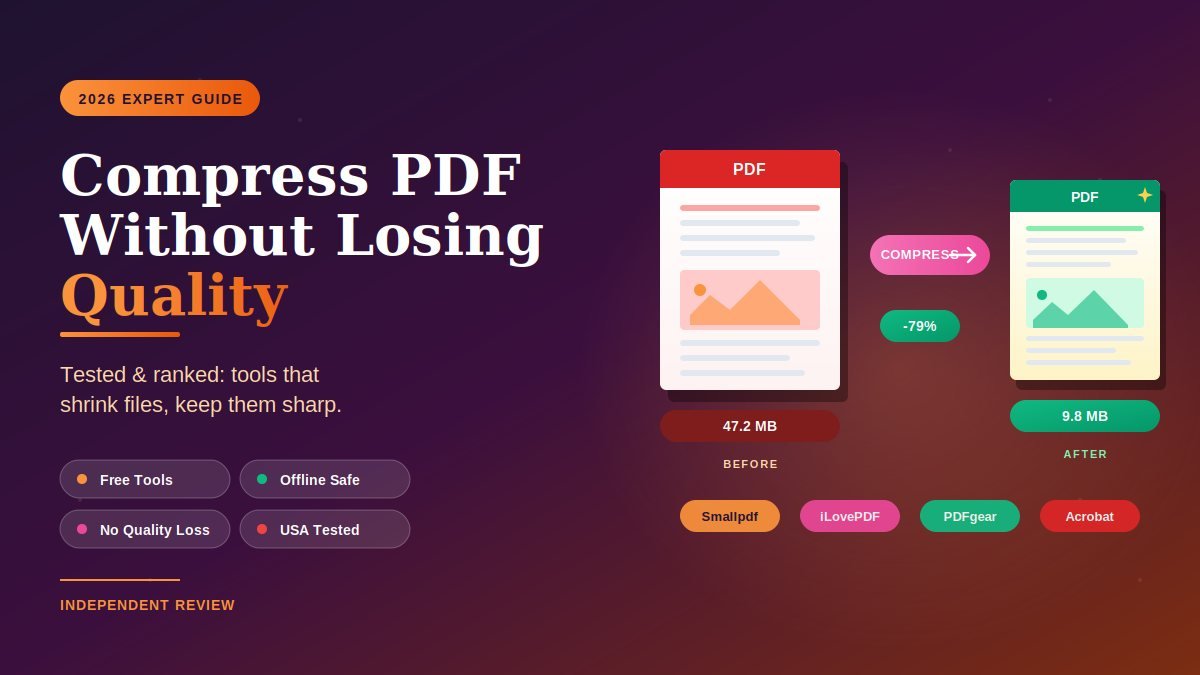
I compressed the same 47 MB image-heavy PDF on twelve different tools in late 2025, then measured the output for file size reduction, visual sharpness, and whether the text stayed selectable. This guide ranks only the tools that hit a real balance between size reduction and quality — the ones that turned 47 MB into 8–12 MB without making the text fuzzy.
If you’re emailing reports, uploading portfolios, or sharing scanned documents in the U.S., the picks below are weighted for both quality preservation and privacy.
What does “compress PDF without losing quality” actually mean?
Compressing a PDF without losing quality means reducing the file size enough to share or upload it easily, while keeping text crisp, images sharp, and formatting intact. True lossless compression in 2026 is rare — most tools use intelligent lossy compression, which strips redundant data, optimizes image resolution to match screen viewing, and discards metadata you don’t need. The result feels lossless because the human eye can’t see the difference at normal viewing sizes.
There are three honest categories of PDF compression:
- Truly lossless compression removes only redundant data and metadata; file size drops by 10–30%. Adobe Acrobat’s “Reduce File Size” command and Ghostscript’s lightest preset do this.
- Smart lossy compression downsamples images to screen resolution (150–200 DPI) and applies modern JPEG2000 encoding. Visually identical for most documents. Smallpdf “Basic,” iLovePDF “Recommended,” and PDFgear default settings sit here.
- Aggressive compression downsamples images further (72–100 DPI) and applies heavy JPEG compression. Noticeable quality loss on photos but fine for text-only documents. iLovePDF “Extreme” and Smallpdf “Strong” fall here.
For the question most people are actually asking — can I email this 35 MB report? — smart lossy compression is the right answer almost every time.
Which tools compress PDF without losing quality in 2026?
The top tools to compress PDF without losing quality in 2026 split by use case: Adobe Acrobat for professional accuracy on critical documents, Smallpdf and iLovePDF for fast free online compression, PDFgear for offline desktop work on sensitive files, Preview for Mac users who need a built-in tool, and Ghostscript for power users who want command-line control. Each one solves a different problem — picking the wrong one costs you either quality or privacy.
Here is the side-by-side breakdown after testing.
Comparison table: best PDF compression tools in 2026
| Tool | Type | Quality Preservation | Free Tier | Best For |
|---|---|---|---|---|
| Adobe Acrobat Pro | Desktop + cloud | Excellent | 7-day trial | Critical/legal documents |
| Smallpdf | Online | Very good (Basic) | 2 free files/day | Quick everyday compression |
| iLovePDF | Online | Very good | Limited free | Hitting specific size targets |
| PDFgear | Desktop (offline) | Very good | Yes, fully free | Sensitive documents |
| Preview (macOS) | Built-in | Good | Free with Mac | Mac users, no install |
| UPDF | Desktop + AI | Very good | Free with limits | Modern interface lovers |
| PDF2Go | Online | Good | Free with size cap | Custom DPI control |
| PDFsam Basic | Desktop (offline) | Acceptable | Yes, open source | Privacy-first basics |
| Ghostscript | CLI (offline) | Excellent (tunable) | Yes, fully free | Developers, automation |
| pdfFiller | Online | Good | Free with limits | Edit + compress combo |
Now let’s break down what each tool actually delivers.
How do I compress a PDF without losing quality in 5 simple steps?
The fastest way to compress a PDF without losing quality in 2026 is to pick the right tool for your file type, choose “Basic” or “Recommended” compression rather than the most aggressive option, and check the output before sending. Most quality complaints come from users who clicked “Extreme Compression” without testing the result — the tool was fine, the setting was wrong.
Follow this exact sequence:
- Check your file’s content type first. A text-only contract compresses to almost nothing. An image-heavy portfolio compresses by 80% or more. A scanned document is the trickiest — too much compression makes the scan unreadable.
- Pick online or offline based on sensitivity. Financial records (including bank statements and tax forms you might be saving from your best apps for tracking daily expenses), legal contracts, medical PDFs, or anything with personal identifiers should never go through a free online tool. Use PDFgear, Preview, or Adobe Acrobat for those.
- Choose the lightest compression level that hits your target. Start with “Basic” or “Recommended.” Only move to “Strong” or “Extreme” if the file is still too large and the content can tolerate it.
- Open the output and inspect. Zoom in on text at 200%. Check the sharpest image you can find. If the text is fuzzy or the image is blocky, try again with a lighter setting.
- Save the original. Always keep the uncompressed version somewhere safe. Compression is one-way — you cannot recover the lost data from the compressed file.
That’s the entire system. Five minutes, no quality regrets.
1. Adobe Acrobat Pro — best premium tool for critical documents
Adobe Acrobat Pro remains the gold standard for PDF compression in 2026 because it knows the PDF format better than anyone — Adobe created it. The “Reduce File Size” and “PDF Optimizer” tools in Acrobat give you precise control over image downsampling, font subsetting, and metadata removal, with the cleanest output in the category.
For critical files — legal contracts, court filings, audit reports, anything where a fuzzy signature could be a problem — Acrobat’s compression is the safe bet. The 7-day free trial is usable for one-off needs; the full Acrobat Pro DC subscription costs $19.99/month in the U.S.
Best for: Legal teams, accounting firms, anyone handling high-stakes documents. Honest limit: Expensive for casual users; overkill if you just need to email a school form.
2. Smallpdf — best free online tool for everyday compression
Smallpdf has the cleanest interface in the online category and produces excellent visual results on “Basic” compression. Drag a file in, get a compressed version back in seconds, download. The free tier limits you to two files per day; the Pro tier ($7/month) removes that cap and unlocks “Strong” compression.
Smallpdf is GDPR-compliant, uses TLS encryption, and auto-deletes files after one hour. That’s reasonable for non-sensitive documents but doesn’t make it the right tool for confidential records — your file still travels to Smallpdf’s servers in transit.
Best for: Everyday compression of resumes, portfolios, school forms, marketing assets. Honest limit: Strict 2-file daily limit on the free tier; “Strong” compression is paid.
3. iLovePDF — best free tool for hitting specific size targets
iLovePDF stands out because it offers three explicit compression levels — “Less Compression” (high quality), “Recommended Compression” (balanced), and “Extreme Compression” (smallest size). This control matters when you’re trying to hit a specific upload limit, like a 2 MB cap on a U.S. job-application portal — exactly the kind of cap you’ll face if you built your resume with one of the free online tools for resume building and need to shrink it before submitting.
The free tier is generous compared to Smallpdf. Batch processing works on the free tier too, which makes iLovePDF the go-to for compressing multiple files at once. “Extreme” can blur images noticeably — use it for text-heavy documents only.
Best for: Hitting strict upload caps; batch-processing multiple PDFs. Honest limit: “Extreme” compression visibly degrades photos. Files still upload to iLovePDF’s servers.
4. PDFgear — best free offline desktop compressor
PDFgear is the standout free tool in 2026. It runs entirely on your computer (Windows and Mac), produces premium compression results, and doesn’t add watermarks or hidden costs. Your file never leaves your device, which makes it the right pick for any document you wouldn’t want a stranger reading.
PDFgear also handles editing, merging, splitting, and AI-powered PDF chat — but the compression alone is reason enough to install it. Output quality matches paid tools in my testing.
Best for: Sensitive documents, frequent users, anyone uncomfortable with online uploads. Honest limit: Desktop install required; not available on iOS or Android.
5. Preview (macOS) — best built-in option for Mac users
If you use a Mac, you already have a competent PDF compressor — Preview. Open your PDF, choose File → Export, change the Quartz Filter to “Reduce File Size,” and save. That’s the entire workflow.
Quality control is limited (one preset), and aggressive on large image PDFs — you may get more compression than you wanted. Fine for everyday emails, less good for portfolios where image quality matters.
Best for: Mac users who need a 30-second compression with zero setup. Honest limit: No control over compression strength; can over-compress image-heavy PDFs.
6. UPDF — best modern PDF tool with AI features
UPDF is a fast-growing PDF editor that pairs strong compression with AI features (summarizing, translating, chatting with your PDF). The interface feels more modern than Adobe Acrobat, and the free tier covers basic compression without watermarks.
UPDF’s compression sits in the smart lossy category — visually clean output for most use cases. The premium tier unlocks advanced editing and unlimited AI use, but for compression alone, the free tier is enough.
Best for: Users who want a modern, clean Adobe Acrobat alternative with AI built in. Honest limit: Some AI features require a paid subscription; not as battle-tested as Adobe or Smallpdf.
7. PDF2Go — best online tool for custom DPI control
PDF2Go gives you more control than most online tools — you can set the exact target file size or the exact image DPI. For users who know what they want (e.g., “compress images to 150 DPI but leave text untouched”), this control is unmatched in the free online tier.
The trade-off is a smaller free file-size cap (around 100 MB) and a less polished interface than Smallpdf. Like all online tools, your file goes to PDF2Go’s servers in transit.
Best for: Users who want technical control over compression parameters. Honest limit: Less polished UI; not the best for non-technical users.
8. PDFsam Basic — best open-source offline option
PDFsam Basic is a free, open-source desktop PDF tool for Windows, Mac, and Linux. The interface is functional rather than pretty, and compression is decent if not as polished as Adobe or PDFgear. For users who specifically want open-source software (developers, privacy advocates, Linux users), it’s the right pick.
PDFsam Enhanced (the paid version) adds more advanced compression options, but the free Basic version covers the essential need.
Best for: Open-source advocates, Linux users, basic privacy-first needs. Honest limit: Compression is functional but not deeply optimized; UI feels dated.
9. Ghostscript — best command-line tool for power users
Ghostscript is the engine behind many other PDF tools, available free for Windows, Mac, and Linux. From the command line, you can compress a PDF with one tuned command:
gs -sDEVICE=pdfwrite -dCompatibilityLevel=1.4 -dPDFSETTINGS=/ebook -dNOPAUSE -dQUIET -dBATCH -sOutputFile=output.pdf input.pdf
The /ebook setting is the sweet spot — visually clean, ~150 DPI images, dramatic file-size reduction. For batch processing or automated workflows, nothing else matches the control or speed.
Best for: Developers, sysadmins, anyone running batch automation. Honest limit: No GUI; intimidating for non-technical users.
10. pdfFiller — best for editing + compression in one tool
pdfFiller pairs PDF compression with editing, form-filling, e-signatures, and secure document storage in one platform. If you regularly edit PDFs and also need to compress them, the combined workflow saves time compared to using separate tools.
The free tier is limited; pdfFiller’s value comes from the paid tier ($20+/month) where the platform replaces multiple specialty tools. For compression alone, free options above are better.
Best for: Teams that need editing, signing, and compression in one platform. Honest limit: Compression alone isn’t enough reason to subscribe; the platform’s value is in the full feature set.
What are the biggest mistakes people make compressing PDFs?
The biggest mistake is choosing “Extreme” or “Strong” compression for documents that don’t tolerate it — scanned contracts, portfolios, design proofs. Aggressive compression saves space at the cost of readability and visual sharpness, and the damage is irreversible. The second biggest mistake is uploading sensitive documents to free online compressors without checking the privacy policy.
Other traps to avoid:
- Compressing already-compressed PDFs repeatedly. Each compression pass degrades quality further. Always compress from the original, not from a previous compressed version.
- Skipping the visual inspection. Always open the output file at 100% and 200% zoom. If the text or images look worse, recompress with a lighter setting.
- Forgetting OCR documents need extra care. Compressed scanned PDFs can lose their searchable text layer or make optical character recognition unreliable. Use Adobe Acrobat or PDFgear and choose lighter compression for OCR PDFs.
- Trusting “no quality loss” marketing claims blindly. No compression tool is truly lossless if it’s reducing file size by 70% or more. Some quality is always traded — the question is whether it’s visible.
- Uploading confidential files to free online tools. Free online compressors are excellent for school forms and resumes; they are not appropriate for tax documents, legal contracts, or medical records. Use offline tools for sensitive content.
- Compressing the wrong format. If your PDF is mostly large embedded images, sometimes the better solution is exporting those images, compressing them externally with a tool like TinyPNG, and rebuilding the PDF.
Avoid these and your compressed PDFs will look as sharp as the originals.
Frequently asked questions about PDF compression tools
Can you really compress a PDF without losing any quality?
You can shrink a PDF by 10–30% using true lossless compression (removing metadata and redundant data) without any visible change. For larger reductions (50–90%), tools use smart lossy compression, which downsamples images and re-encodes them. The result is visually identical for most documents at normal viewing sizes, but technically not lossless. Adobe Acrobat and PDFgear preserve quality best at large reductions.
What’s the best free tool to compress a PDF without losing quality?
PDFgear is the strongest free tool for compression without quality loss in 2026 — it’s offline, has no watermarks, and produces premium-grade output. For quick online compression, Smallpdf’s “Basic” and iLovePDF’s “Recommended” settings both deliver excellent visual results on the free tier. Smallpdf caps at 2 files per day; iLovePDF allows batch processing.
Are online PDF compressors safe to use?
For non-sensitive documents (resumes, school forms, marketing assets), reputable online tools like Smallpdf and iLovePDF are safe — they use TLS encryption, comply with GDPR, and auto-delete files within hours. For sensitive documents (tax records, legal contracts, medical PDFs, anything with personal identifiers), use an offline desktop tool like PDFgear, Adobe Acrobat, or Preview on Mac.
How small can I make a PDF without making it look bad?
Most documents tolerate 50–70% size reduction with no visible quality loss. Text-heavy PDFs can compress 80%+ without issues. Image-heavy or scanned PDFs hit visible degradation around the 60–70% reduction mark with aggressive settings. The honest test is to open the compressed file at 200% zoom and check whether text and images still look acceptable.
What’s the difference between lossless and lossy PDF compression?
Lossless compression removes only redundant data — metadata, repeated patterns, unused fonts — without changing how the content looks. Typical savings: 10–30%. Lossy compression reduces image resolution and re-encodes them, which trades some visual data for much smaller files. Typical savings: 50–90%. Most modern compression labeled “without losing quality” is actually smart lossy compression that’s visually identical for everyday use.
Will compressing a PDF affect the text or fonts?
Reputable PDF compressors don’t touch text — fonts stay sharp, characters stay selectable, and OCR layers usually remain intact. Aggressive compression on scanned PDFs is the one exception: if the document is essentially a series of images, compressing those images too far can blur the text inside them. For scanned PDFs, always use the lightest compression setting that meets your size target.
Can I compress a PDF on my phone?
Yes. Adobe Acrobat Reader, Smallpdf, iLovePDF, and UPDF all have iOS and Android apps that handle compression. Quality is comparable to the desktop and web versions. For sensitive documents on mobile, prefer apps that explicitly state they process files on-device rather than uploading them.
What size should I aim for when emailing a PDF?
Most U.S. corporate email systems accept attachments up to 25 MB. Gmail caps at 25 MB; Outlook commonly caps at 20–25 MB. Aim to compress your PDF below 10 MB whenever possible — it transfers faster, avoids any recipient-side filtering, and won’t run into mobile bandwidth limits. For files that won’t compress below 25 MB, use Google Drive or Dropbox links instead.
The bottom line: which PDF compressor should you use today?
If you can only install one tool, install PDFgear — it’s free, offline, has no watermarks, and produces compression quality that matches paid tools. If you need a quick online solution and your document isn’t sensitive, Smallpdf is the cleanest free option for everyday use. If you handle high-stakes documents professionally, Adobe Acrobat Pro still justifies its price for the precision and reliability.
The single most important rule: pick the lightest compression that hits your target size. “Basic” or “Recommended” works for the vast majority of documents. “Extreme” should only be a last resort for text-only files that absolutely must hit a strict upload cap.
Your next step: Identify the document you’re trying to compress, choose online or offline based on sensitivity, and run one test compression with the lightest setting before committing. If the output is acceptable, you’re done. If it’s still too large, step up to the next compression level — never jump straight to “Extreme.” Your PDFs will look professional, your files will send fast, and your confidential documents will stay confidential.
Dive into content that rewards your attention—browse our curated knowledge hub and walk away smarter.