
Expert Guide: How Ski Jumpers Stay in the Air So Long
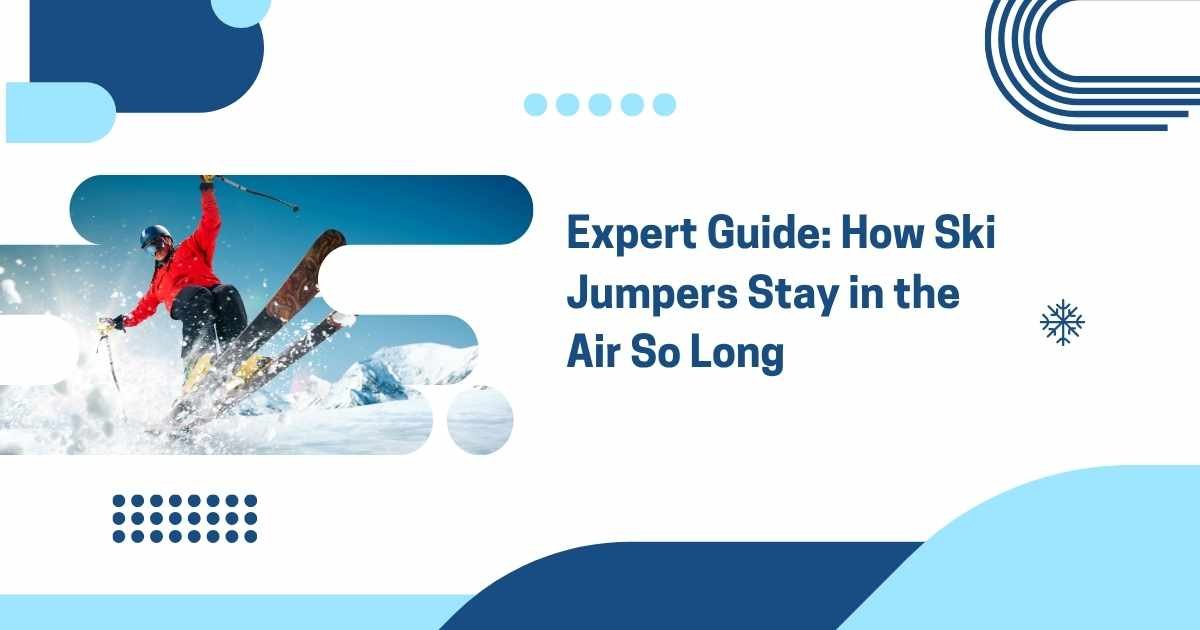
Watch a ski jumper for the first time and your brain short-circuits. A human being launches off a ramp at nearly 100 mph, leans forward at an impossible angle, and just… glides. For up to eight seconds. Across distances longer than a football field.
Your gut says that can’t be real. But it is — and the physics behind it are surprisingly understandable once someone breaks them down clearly.
This article covers exactly how ski jumpers generate aerodynamic lift, why their body position is everything, what forces are fighting each other mid-air, and the brutal, science-driven training that makes it all possible. No fluff. Just the real mechanics.
How Ski Jumpers Actually Generate Lift (They Become a Wing)
Most people assume ski jumpers stay airborne because they have massive momentum from the ramp. Momentum matters — but it’s only half the story. The bigger answer is aerodynamic lift, and understanding it changes how you’ll watch the sport forever.
When a jumper leaves the takeoff table, they’re traveling at roughly 85–105 km/h (53–65 mph). At that speed, air becomes a physical force. By angling their body and skis at roughly 25–35 degrees relative to the oncoming airflow, the jumper creates a pressure differential — higher pressure underneath, lower pressure on top. That pressure gap pushes upward. That upward push is lift.
This is the exact same principle that keeps a commercial airplane airborne. The jumper doesn’t just jump; they become a wing.
The Four Forces Fighting Over Every Jump
At any moment during flight, four forces are in constant competition:
- Lift — the upward aerodynamic force generated by the jumper’s body and skis acting as a wing
- Drag — the air resistance pushing backward against forward motion
- Gravity — pulling the jumper straight down at 9.8 m/s²
- Inertia — the forward momentum built during the inrun
The goal of every elite jumper is to maximize lift, minimize drag, and let inertia carry them as far as possible before gravity wins. When those forces are optimally balanced, flight time stretches to 7–9 seconds on large-hill and ski flying events.
According to research published in the journal Frontiers in Sports and Active Living (2025), even a 2 cm change in suit size increases drag by 4% and lift by 5% — showing just how sensitive these aerodynamic forces are to tiny physical changes.
Why Speed Matters More Than You Think
The inrun isn’t just about generating forward motion — it’s about generating lift potential. That’s because lift is proportional to the square of velocity. Double the speed and you don’t double the lift — you quadruple it. Every extra kilometer per hour on the inrun translates into a meaningful aerodynamic advantage once airborne.
By the time jumpers reach the takeoff table on the largest “ski flying” hills, they can be hitting speeds close to 110 km/h. That’s not recklessness — that’s aerodynamic engineering.
The V-Style: The Technique That Changed Everything
For most of ski jumping’s history, athletes held their skis parallel — pointed straight ahead. Then, in 1985, a Swedish jumper named Jan Boklöv started experimenting with something unusual: spreading his skis into a V-shape, tips angled outward.
The ski jumping establishment hated it. Style judges gave him lower scores. Traditionalists called it ugly. But the results were undeniable.
The V-style generates approximately 28% more lift than the parallel technique, according to aerodynamic analysis published in research comparing the two styles. By the early 1990s, every competitive jumper in the world had switched. No exceptions.
Why the V Works
The V-position does three things simultaneously:
1. Increases surface area. Spread skis create a wider wing. More surface area means more air being deflected downward, which generates more upward lift force.
2. Optimizes angle of attack. The V allows the jumper to present the most aerodynamically efficient angle to the oncoming airflow — roughly 30–35 degrees — without increasing drag proportionally.
3. Integrates body and skis into one continuous lifting surface. The jumper’s torso fits between the V, turning the entire body-plus-ski system into a single, cohesive airfoil from ski tip to ski tip.
Today, elite jumpers refine the exact V angle constantly — in wind tunnels, through video analysis, and across thousands of practice jumps. Even a 5-degree variation in the V angle can measurably affect distance.
The Takeoff: A 0.3-Second Window That Determines Everything
Here’s what most broadcast commentary doesn’t tell you: the single most critical moment in a ski jump is not the glide — it’s the takeoff. The jumper has a window of roughly 0.2–0.3 seconds to generate the additional upward velocity needed to optimize their flight trajectory.
Miss that window by even a fraction and the jump is compromised before it starts. Physics Professor Amy Pope of Clemson University, who wrote about ski jumping for Smithsonian Magazine, has explained that this explosive leg extension at the exact right millisecond is what separates elite jumpers from good ones.
The takeoff demands the reflexes of a sprinter, the explosive power of a weightlifter, and the timing precision of a concert pianist — simultaneously.
How Ski Jumpers Train: The Year-Round System Most People Never See
Here’s the thing most casual viewers don’t realize: elite ski jumpers spend only a small fraction of their training time actually jumping. The rest happens in wind tunnels, gyms, on summer plastic ramps, and — increasingly — in highly controlled simulation environments.
1. Wind Tunnel Training
Wind tunnels are where aerodynamic position is built. As Science Friday reported in its coverage of the U.S. Olympic team’s preparation, in the past, jumpers typically had only 3–4 seconds per actual jump to practice mid-air aerodynamics. Wind tunnels changed that — allowing athletes to hold flight positions for extended periods while coaches analyze airflow, pressure distribution, and body angle in real time.
During a wind tunnel session, athletes can test micro-adjustments — slightly different arm angles, head positions, torso lean — and immediately see the aerodynamic impact. This kind of feedback loop is impossible during an actual jump.
2. Dry-Land Strength Training
Ski jumping is explosive. The takeoff demands fast-twitch muscle fiber activation that produces maximum force in under a third of a second. Training for this involves:
- Plyometric work — box jumps, depth jumps, and single-leg bounding to develop the explosive leg power needed at takeoff
- Core stability drills — the in-flight position requires holding a near-horizontal torso for up to 9 seconds; without serious core strength, that position collapses
- Balance and proprioception training — micro-adjustments in the air are made through tiny weight shifts; this requires elite body awareness that has to be trained deliberately
3. Summer Ramp Training
Snow isn’t available year-round, but training is. Most elite programs use plastic-matted ramps and water landing ramps to allow jumpers to train their technique through spring, summer, and fall. Clubs like the Blackhawk Ski Jumping Team in the U.S. train on plastic surfaces from May through November, using rope tows to dramatically increase the number of jumps per session.
Water landing ramps remove the fear of a hard landing, allowing athletes to push into new positions they’d otherwise be too cautious to try on snow.
4. Video and Biomechanical Analysis
Modern ski jumping programs track every jump with high-speed cameras and GPS systems. A 2023 study published in NCBI used differential Global Navigation Satellite Systems (dGNSS) to measure continuous position data, velocity, and aerodynamic forces during actual competition jumps — showing clear differences in strategy between World Cup athletes and lower-tier competitors.
Elite World Cup athletes in that study focused on maximizing horizontal velocity during flight, while less experienced athletes prioritized minimizing vertical velocity. That’s a meaningful strategic difference that coaches now use to guide training decisions.
5. Mental Training
Landing a 130-meter jump requires approaching a ramp at 100 km/h and leaping off the edge while executing a precise, split-second body movement. The mental preparation is as demanding as the physical. Programs include visualization training, pressure simulation, and performance psychology — because at the elite level, the physical skill gap between top competitors is tiny; the mental edge is where championships are decided.
Common Myths and Misunderstandings About Ski Jumping
Myth 1: They’re just riding momentum
This is the most common misconception. Momentum explains why the jumper travels forward — but not why they stay aloft for 7–9 seconds instead of 2–3. The sustained flight time comes from actively generated aerodynamic lift, not passive coasting. Remove the V-style position and replace it with an upright stance, and flight time drops dramatically.
Myth 2: Heavier athletes jump further because they have more momentum
The opposite is actually true. Lighter athletes have a better lift-to-weight ratio — the same aerodynamic lift surface carries less gravitational load. This is why ski jumping has historically had troubling weight pressures: lighter athletes genuinely fly further, all else being equal. The FIS now penalizes athletes with BMI below 21 by mandating shorter skis, reducing their aerodynamic advantage — an attempt to counteract dangerous weight management. Research cited in ScienceDirect found that some World Cup ski jumpers had BMIs as low as 16.6.
Myth 3: The suit is just for aerodynamics
Suits are enormously important aerodynamically — but they’re also strictly regulated for fairness. During the 2023–2025 World Cup seasons, 139 male jumpers were disqualified for unregulated suits, with 93% of those cases related to excess suit size. At the 2025 World Championship in Trondheim, five jumpers were suspended under suit manipulation suspicion. A 2 cm difference in suit size measurably shifts both drag and lift — it’s not a cosmetic issue.
Myth 4: Ski jumping is just a European sport
The U.S. has had a legitimate ski jumping tradition for over a century. American facilities like the Blackhawk Ski Club in Wisconsin, the Minneapolis Ski Jumping Club in Minnesota, and the Utah Olympic facilities have produced competitive athletes at the national and international level. Sarah Hendrickson became the first American woman to compete in Olympic ski jumping in 2014 and has trained with wind tunnel technology alongside the U.S. national team.
Frequently Asked Questions
How long do ski jumpers actually stay in the air?
On normal competition hills, flight time ranges from about 4–6 seconds. On large hill events, it typically reaches 6–8 seconds. On the biggest “ski flying” hills — where athletes regularly exceed 200 meters — jumpers can remain airborne for up to 9 seconds. That’s roughly the time it takes to read this sentence twice.
Why don’t ski jumpers fall flat forward when they lean so far?
Their horizontal torso position is aerodynamically supported by upward lift force, the same principle keeping an airplane wing level. The air flowing over and under the jumper at 90+ km/h creates enough upward pressure to support a forward-leaning torso — as long as the body angle is precisely maintained.
How dangerous is ski jumping, really?
The sport is designed with safety in mind. The landing hill is engineered to roughly mirror the jumper’s flight path, which means athletes are rarely more than 10–15 feet above the surface at any point. Falls happen, but the angled slope reduces impact force significantly compared to landing on flat ground. Serious injuries occur, but fatalities are extremely rare in modern competition.
At what age do ski jumpers start training?
Most elite jumpers begin on small practice hills between ages 7–10, starting with very short jumps — sometimes just 8–10 meters — and progressing gradually. American clubs like the Minneapolis Ski Jumping Club have structured programs for athletes as young as 5. National-level athletes typically begin serious competitive training in their early teens.
Why do ski jumpers hold their arms behind them mid-air?
Arms tucked behind the body reduce frontal drag and help integrate the arms into the overall aerodynamic profile. Arms flared outward would increase air resistance and disrupt the smooth airflow over the body. It’s aerodynamics, not style.
What is “ski flying” and how is it different from regular ski jumping?
Ski flying uses larger hills with longer inruns, generating higher speeds and greater lift. The current world record — held by Stefan Kraft at 253.5 meters — was set on a ski flying hill in Vikersund, Norway. Standard competition hills produce distances in the 120–145 meter range; ski flying hills routinely see jumps over 200 meters.
Can you learn ski jumping as an adult in the U.S.?
Yes — with caveats. Clubs like Blackhawk in Wisconsin and the Minneapolis Ski Jumping Club offer structured adult introduction programs. You’ll start on very small training hills (8-meter jumps) and progress only with demonstrated competence. Adults can absolutely learn, but Olympic-level athletes typically need to begin in childhood to develop the proprioceptive instincts the sport demands.
Conclusion
Ski jumping looks supernatural. It isn’t. It’s physics, technique, and a training system so precise it accounts for a 2 cm difference in suit fabric.
The jumper becomes a wing. The V-style maximizes lift. The explosive takeoff sets the trajectory. And the aerodynamic position — held perfectly for up to nine seconds at 90 mph — is the result of thousands of hours in wind tunnels, on plastic ramps, and in weight rooms.
The next time you watch ski jumping, you’ll see it differently: four forces in constant negotiation, a human aircraft in sub-zero air, and an athlete who has spent years learning to fly.
Want to go deeper? Look up FIS World Cup ski flying results from Vikersund, Norway — where Stefan Kraft’s 253.5-meter world record was set — and watch the flight footage in slow motion. Once you know what you’re looking for, every second of it makes complete sense.
Disclaimer
The information provided in this article is for general informational and educational purposes only. It does not constitute professional sports, medical, or safety advice. Ski jumping is an inherently dangerous sport that involves significant risk of serious injury or death. Always seek proper instruction, equipment, and supervision from certified professionals before attempting any ski jumping activities. The author and publisher assume no responsibility for any injuries, losses, or damages resulting from the use or misuse of the information contained in this guide. Individual results and techniques may vary based on skill level, physical condition, and environmental factors. Consult with qualified coaches, sports physicians, and safety officials before engaging in any high-risk winter sports activities.
Turn ideas into action – explore tools and frameworks that work.