
Corbett vs Ranthambore: Expert Wildlife Photography Guide
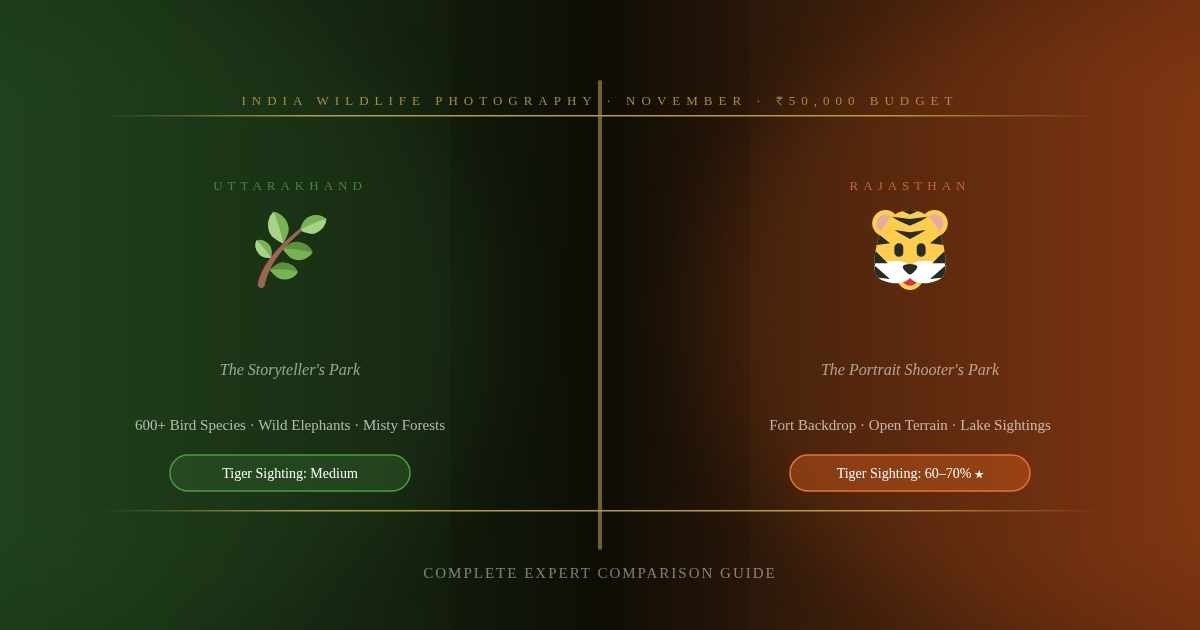
You have five days, ₹50,000, and one question that no one is answering clearly: which park actually gives you better photos in November — Corbett or Ranthambore? Most guides dance around the answer. This one doesn’t.
I’ve broken down both parks by tiger sighting probability, photography zones, light quality, safari costs, and what a realistic day-by-day schedule looks like — all within your budget. By the end of this guide, you’ll know exactly where to book, which zones to target, and how to spend every rupee for maximum return.
01 / November Conditions What Each Park Actually Looks Like in November
November sits in a sweet spot for Indian wildlife: post-monsoon foliage is still lush, temperatures are cool, and animals have settled into predictable water-source routines. But the way these conditions play out in Corbett versus Ranthambore is dramatically different.
Jim Corbett in November
Uttarakhand Corbett’s November mornings are cold and misty — temperatures can dip to 5–10°C at dawn in the Dhikala and Bijrani zones. The Ramganga River creates a low fog that rolls across the grasslands, producing atmospheric, painterly light that landscape photographers dream about. Early mornings before 8 AM give you a golden, diffused quality that punches through the Sal forest canopy.
Critically, Dhikala zone reopens in mid-November after the monsoon closure. If you’re planning to visit, confirm your dates around the 15th onwards. Dhikala is Corbett’s premier photography zone — open grassland, riverbeds, and direct sightlines that the dense Bijrani cannot match.
Ranthambore in November
Rajasthan Ranthambore in November is Ranthambore at its sharpest. The monsoon dust has settled, visibility is long, and the dry deciduous trees are shedding leaves — which means fewer obstructions between your lens and the animal. Temperatures are comfortable (15–25°C by afternoon), and tigers gravitate toward the three major lakes: Padam Talao, Rajbagh Talao, and Malik Talao. These predictable gathering spots are what give Ranthambore its 60–70% tiger sighting success rate in peak winter months.
02 / Safari Zones & Photography Style Where You Shoot and What You’ll Capture
Zone selection is the single most important decision you’ll make on this trip. A wrong zone booking in Ranthambore can halve your chances. In Corbett, it can mean the difference between a forest track sighting and a wide open grassland chase.
| Parameter | Jim Corbett | Ranthambore |
|---|---|---|
| Best Zone | Dhikala (open grass + river) | Zones 2, 3, 4 (tiger territories) |
| Tiger Sighting Odds | Medium — dense forest cover | 60–70% — open terrain advantage |
| Photographic Terrain | Rivers, mist, elephant herds, birds in flight | Lakes, ruins, open scrub, fort backdrop |
| Safari Vehicle | Full jeep (6 pax) — book entire vehicle | Single seat canter (20 pax) or shared gypsy |
| Light Quality | Soft, diffused, misty morning glow | Warm, golden, high-contrast |
| Tiger Behaviour | Elusive, deep forest movement | Habituated — comfortable near vehicles |
| Advance Booking Need | 2–3 months for Dhikala | 45–60 days for Zones 1–5 |
| Elephants | Yes — wild herds on Ramganga riverbank | No |
| Unique Backdrop | Himalayan foothills, Sal forest | 1,000-year-old Ranthambore Fort, ruins |
Photography Style: What Portfolio Are You Building?
🌿 Jim Corbett — The Storyteller’s Park
- Mist + muted greens for moody compositions
- Elephant herds crossing Ramganga River
- 600+ bird species including migratory species
- 70–200mm f/2.8 works well in low forest light
- Wide-angle riverscape and landscape frames
- Environmental portraits over isolated portraits
🐯 Ranthambore — The Portrait Shooter’s Park
- Clean backgrounds, tiger sharply isolated
- Fort ruins as dramatic compositional anchors
- You can see a tiger from 200m — swap lenses calmly
- 100–400mm or 200–600mm ideal focal range
- Crocodiles resting at Padam Talao — bonus shots
- Historical context adds depth to wildlife frames
In Ranthambore, you see a tiger approaching from 200 metres. You have time to switch lenses, adjust ISO, choose your angle. In Corbett, you get five seconds as a tiger crosses a forest track. Both are thrilling — but for a five-day trip with a single chance, Ranthambore’s open terrain gives you more margin for error.
— Wildlife Photography Insight, verified by field experience across 8+ Indian tiger reserves03 / The ₹50,000 Budget Breakdown Where Every Rupee Goes at Each Park
I’ve broken down a realistic solo 5-day trip budget for both parks. The numbers assume budget-mid accommodation (not luxury resorts), shared safaris where possible, and train travel from Delhi.
Key budget insight: Corbett’s jeep system charges per vehicle (₹6,500–9,500), which makes it expensive for solo travelers. In Ranthambore, canters let you book a single seat at ₹1,200–1,600. For solo photographers, Ranthambore delivers significantly more safari time per rupee. If you’re traveling with 4–6 people, Corbett’s economics improve dramatically.
Recommended Lens Setup Within Budget
| Park | Primary Lens | Secondary | Why |
|---|---|---|---|
| Ranthambore | 100–400mm f/4.5–5.6 or 200–600mm | 70–200mm f/2.8 (backup) | Long sightlines, portrait compression at distance |
| Corbett | 70–200mm f/2.8 | 400mm for elephant/bird shots | Dense forest, low-light dawn — fast glass wins |
| Both Parks | Dust/moisture protection sleeve | 2 spare batteries minimum | Ranthambore dust; Corbett river mist |
04 / Day-by-Day Itinerary What 5 Days Actually Looks Like at Each Park
🐯 Ranthambore — 5-Day Photography Itinerary
Board the Rajdhani Express from Delhi (5–6 hours). Check into a budget guesthouse on Ranthambore Road. Walk the town at dusk, calibrate your camera settings for the morning. Sleep by 9 PM — your first safari is at 6 AM.
Morning golden hour: target Padam Talao shoreline for tiger movement. Afternoon: Zone 2 for the iconic fort backdrop compositions. Book a gypsy (not canter) for both slots if you can stretch ₹2,500 more — the smaller vehicle means fewer competing cameras.
Zone 4 covers Raj Bagh Talao — excellent for crocodile shots and any tiger movement from Zone 3 territory. Afternoon: visit the Ranthambore Fort on foot (free after 3 PM) for landscape reference shots. An hour there gives you context for tomorrow’s compositions.
Zone 5 is quieter — ideal for leopard movement and undisturbed bird shots. Return to Zone 3 in the afternoon: if you missed a tiger sighting, this is your best statistical retry. Most photographers who see their best shots on Day 4 did so by coming back.
Final morning: walk the Malik Talao area at sunrise independently (no safari required). Trains to Delhi depart mid-morning — check the 09:15 Superfast from Sawai Madhopur to reach Delhi by 2 PM comfortably.
🌿 Jim Corbett — 5-Day Photography Itinerary
Train to Ramnagar (Kathgodam Express, 6–7 hrs). Check into a guesthouse outside the gate — staying outside saves ₹6,000+ vs. Dhikala rest house rates. Bijrani afternoon safari for orientation and bird photography in the golden hour.
Dhikala day safari is the crown jewel of Corbett. Arrive at the gate at 5:45 AM. Spend the full day inside — you cannot re-enter after leaving. This is where elephant herds cross the Ramganga at 7–9 AM in November. Carry your own lunch. This single safari justifies the Corbett trip.
Bijrani offers dense forest sightings — different visual vocabulary from Dhikala’s open spaces. After the afternoon exit, spend 2 hours with a local birding guide around the Kosi River (₹800, worth every rupee). November is peak migratory bird season at Corbett.
Book Dhikala again if availability permits (check 45 days ahead). The second visit almost always yields different subjects — this is when repeat photographers find their best tiger frames. Evening: walk the Kosi riverbank for landscape and reflected-light shots.
Jhirna stays open year-round and is often overlooked. It has consistent sloth bear activity and excellent leopard odds in November. Morning 6–10 AM safari, then drive to Ramnagar for the afternoon train back to Delhi.
05 / Mistakes & Myths What Photographers Get Wrong About This Decision
-
Booking any zone without research
Ranthambore Zone 7 to 10 (buffer areas) and Corbett’s Sonanadi zone are not bad parks — they’re different parks. If you’re in Zone 8 expecting Zone 3 sightings, you will leave disappointed. Always cross-check zone-specific tiger sighting reports from the last 30 days on wildlife photography forums before confirming your booking.
-
Assuming one safari is enough
Even at 60–70% sighting rates, Ranthambore doesn’t guarantee a tiger on your first ride. Budget for at least 3–4 safaris across your 5 days. The photographers who come back with the best shots are not luckier — they simply go out more times.
-
Treating ₹50k as the ceiling, not the framework
You can do both parks comfortably within ₹50,000 — and still have ₹15,000–28,000 remaining for gear upgrades, better stays, or a photography guide. The mistake is blowing ₹18,000 on a luxury jungle resort that cuts your safari budget in half.
-
Ignoring the guide’s photography awareness
A standard naturalist finds animals. A photography-aware guide positions the vehicle relative to the sun, anticipates movement direction, and waits for the right angle. When booking, specifically ask: “Do you work with wildlife photographers?” Tip generously when they deliver — it keeps the culture alive.
-
Skipping the November Dhikala window in Corbett
Dhikala reopens mid-November. Many photographers book for the first week and miss it entirely. Check the Forest Department of Uttarakhand’s official portal for exact reopening dates each year. If your dates are flexible, a Nov 15–20 window at Dhikala is unbeatable in terms of light, mist, and elephant density.
-
Choosing based on park reputation, not photographic intent
Both parks are excellent. The question is not which park is “better” — it’s which park matches how you see nature. If you want clean, identifiable tiger portraits for social media or stock photography, Ranthambore. If you want moody, layered storytelling shots for a portfolio or exhibition, Corbett.
06 / Frequently Asked Questions What People Ask Before Booking This Trip
Expert Verdict: Which Park Should You Choose?
After breaking down both parks across zones, light, budget, and sighting rates — here is the direct answer:
Choose Ranthambore if you want the highest probability of clean tiger portrait shots in 5 days with a solo or duo budget. The open terrain, habituated tigers, and flexible canter seat booking make it the statistically smarter choice for a short, focused photography trip.
Choose Jim Corbett if you’re building a diverse wildlife portfolio — elephants, 600+ bird species, misty riverscapes, and atmospheric forest light. Traveling with 4–6 people also makes Corbett’s jeep economics competitive. The Dhikala zone in mid-to-late November is one of the most visually extraordinary places in India.
Pro strategy if you have flexibility: 3 days Ranthambore (Zones 2–4) + 2 days Corbett (Dhikala). This hybrid approach, possible within ₹50,000 if you travel smart, gives you the portrait shots and the storytelling frames.
Ready to Plan Your Trip?
Book Ranthambore safaris at the official Rajasthan Forest Department portal at least 45–60 days ahead. For Corbett’s Dhikala zone, plan 2–3 months in advance. Permits sell out fast in November — don’t wait. Your best wildlife photographs are 5 days away.
Boost your productivity with actionable advice from industry leaders.