
Cadillac LYRIQ Driving Modes: Complete Range & Battery Guide
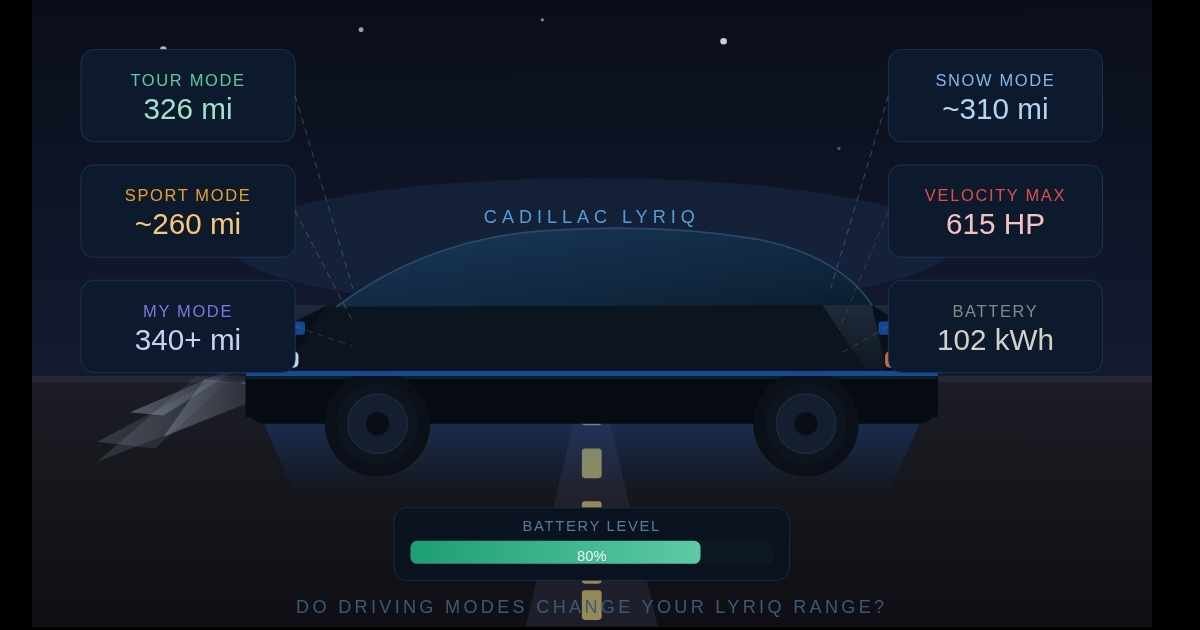
If you own a Cadillac LYRIQ — or you’re shopping for one — this question hits differently than it sounds. You’re not just curious. You’re planning a road trip, calculating your daily commute, or wondering whether Sport mode is silently draining your battery every morning before you hit the highway.
The short answer: yes, Cadillac LYRIQ driving modes do affect your real-world range and battery consumption — and the difference is bigger than most people expect. We’re talking a real-world swing of up to 50–70 miles between the most efficient and most aggressive settings on the same full charge.
Here’s what makes this interesting: the battery itself never changes. It’s fixed at 102 kWh regardless of which mode you select. But the rate at which that energy leaves the pack? That changes dramatically. This guide breaks down every available mode, gives you real numbers from EPA data and owner reports, and tells you exactly when to use each one to get the most from your LYRIQ.
What Driving Modes Does the Cadillac LYRIQ Actually Offer?
The LYRIQ uses Cadillac’s Driver Mode Control system, accessible through the 33-inch curved LED infotainment display. The modes available depend on your trim and model year:
Tour Mode — The default everyday setting. Balanced throttle response, smooth ride, maximum efficiency.
Sport Mode — Sharpens throttle response, tightens steering, firms up the suspension. Prioritizes driving feel over range.
Snow/Ice Mode — Softens accelerator input, carefully distributes torque for slippery roads. Safety takes priority.
My Mode — Fully customizable. You independently set acceleration feel, brake sensitivity, steering weight, and cabin sound.
V-Mode (2026 LYRIQ-V only) — Performance-tuned preset exclusive to the V-Series trim, feeds into Velocity Max.
Velocity Max (2026 LYRIQ-V only) — Full power override. Unlocks 615 horsepower and 650 lb-ft of torque. Not for daily use.
One important distinction from Cadillac themselves: none of these modes are dedicated range extenders. The LYRIQ has no “Eco Mode” button. The modes were designed around performance and comfort — and their range impact is a byproduct of how aggressively they draw power from the Ultium battery.
How Each Driving Mode Affects Your LYRIQ’s Range and Battery Usage
Here’s where the real data comes in. Let’s go mode by mode.
Tour Mode: Your Range Champion
Tour Mode is the setting your EPA range figures are based on. It consistently delivers the most miles per kilowatt-hour because it keeps throttle response relaxed, regenerative braking active, and power delivery smooth.
Based on EPA data and owner testing, Tour Mode on the RWD LYRIQ achieves approximately 3.3–3.7 miles per kWh in mixed real-world driving. At that efficiency rate on a 102 kWh pack, you’re realistically looking at 310–326 miles — matching or coming very close to Cadillac’s EPA-estimated 326 miles for the 2026 RWD model.
The reason Tour Mode wins on range: it doesn’t just reduce performance. It actively enables the regenerative braking system to work at its most effective, recapturing kinetic energy every time you decelerate. On an urban commute with frequent stops, this compounds over dozens of deceleration events per trip.
Use Tour Mode for: Highway trips, long commutes, any drive where arriving with charge to spare matters. It’s the mode Cadillac engineered the LYRIQ’s range figures around.
Sport Mode: The Range Penalty Is Real
Sport Mode changes the LYRIQ’s character entirely. The throttle responds with more urgency, steering feels sharper, and AWD models keep both motors spinning and ready to deploy simultaneously. It’s genuinely fun. It also costs you miles.
Owner reports and efficiency data consistently show Sport Mode reduces available range by 15–25% compared to Tour Mode. On the RWD LYRIQ rated at 326 miles in Tour, Sport Mode real-world range typically lands between 245–280 miles depending on how actively you push the accelerator.
Why the penalty? Two reasons. First, sharper throttle mapping means you’re drawing more current from the battery for any given accelerator input. Second, on AWD models, Sport keeps both the front and rear motors powered up and ready — drawing continuous energy even during steady cruising.
Owner data from LYRIQ forums backs this up: drivers who commute daily in Sport Mode report charging noticeably more often than those using Tour Mode for identical routes.
Use Sport Mode for: Canyon roads, spirited weekend drives, or short trips where fun matters more than efficiency. Don’t use it as your daily default if range is a concern.
Snow/Ice Mode: Moderate and Manageable
Snow/Ice Mode occupies an interesting middle ground. It softens the accelerator pedal response to prevent wheelspin on slippery surfaces and manages torque distribution between front and rear motors more conservatively on AWD models.
In terms of battery usage, Snow/Ice Mode is neither maximally efficient nor wasteful. It doesn’t spike energy consumption the way Sport Mode does, but conservative torque management and traction control interventions mean you won’t match Tour Mode efficiency either. Expect range roughly in line with normal Tour Mode use, with slight variation depending on road conditions.
The critical note: don’t use Snow/Ice Mode on dry, clear roads. It was engineered for traction, not efficiency. On dry pavement, the softened throttle response and traction interventions actively reduce efficiency without providing any safety benefit.
Use Snow/Ice Mode for: Exclusively when road conditions demand it. Switch back to Tour when roads clear up.
My Mode: The Efficiency Wildcard
My Mode is the most interesting setting in the LYRIQ lineup because — configured correctly — it can actually outperform Tour Mode.
The configuration that matters: set accelerator response to its most gentle setting, maximize regenerative braking aggressiveness, and pair this with the Regen on Demand paddle on the steering wheel. This combination can push the LYRIQ to 4.0–4.3 miles per kWh in urban stop-and-go traffic — beating standard Tour Mode by a measurable margin.
This works because aggressive regenerative braking in city traffic recaptures significant energy that would otherwise be lost as heat. Every time you lift off the throttle in a heavily regen-tuned My Mode, the electric motor reverses function and acts as a generator, feeding recovered energy back into the 102 kWh pack.
Configure My Mode for performance instead — sharp throttle, minimal regen — and you’ll land at Sport Mode efficiency with the same range penalty.
Use My Mode for: Maximum regen and gentle throttle for city driving (beats Tour Mode). Performance settings for spirited drives (matches Sport Mode penalties).
Velocity Max and V-Mode: The Performance Outliers
These modes are exclusive to the 2026 LYRIQ-V and operate differently from everything else.
Velocity Max isn’t a standard drive mode you select and cruise around in. It’s a power override: when activated and the accelerator hits the floor, the system delivers the full 615 horsepower and 650 lb-ft of torque from the dual-motor setup. At any other throttle position, the car returns to its standard V-Mode behavior.
The EPA-estimated range for the LYRIQ-V is 285 miles — already lower than the standard LYRIQ’s 326 miles due to the higher-output dual-motor configuration and performance suspension. Activate Velocity Max regularly and that figure drops substantially further. Cadillac explicitly notes this mode is not intended for daily use.
V-Mode itself is the LYRIQ-V’s customizable performance preset, similar to My Mode on standard trims but with additional chassis tuning options including Competitive Mode for traction management and access to Launch Control for 0–60 mph in 3.3 seconds.
Use V-Mode/Velocity Max for: Track days, performance demonstrations, and launch control moments. Expect real-world highway range closer to 250–260 miles in regular V-Series driving.
The Factors That Matter Even More Than Mode Selection
Here’s the honest truth most LYRIQ articles skip over: driving mode selection is important, but it’s not always the biggest variable in your real-world range.
Speed is the biggest drain. Car and Driver’s highway range test on the RWD LYRIQ — conducted in Tour Mode — returned only 270 miles against the EPA figure of 314 miles. That 44-mile gap comes almost entirely from highway speed. Above 70 mph, aerodynamic drag increases exponentially and destroys EV efficiency regardless of mode.
Wheel size matters more than people expect. Larger 22-inch wheels — available on higher LYRIQ trims — increase rolling resistance and unsprung weight. Owner surveys show 22-inch wheels cause 3–5% lower efficiency compared to 19 or 20-inch options, making wheel choice one of the most overlooked range variables at purchase time.
Battery preconditioning is free range. Always precondition your LYRIQ’s battery while it’s still plugged in before a cold-weather drive. Cold batteries operate less efficiently and must divert energy to thermal management. Starting with a pre-warmed battery means stored charge goes to moving the car, not heating the cells.
Charge to 80% for daily use. This preserves long-term battery health and leaves headroom for regenerative braking. A battery at 100% cannot accept energy from regen — recovered energy has nowhere to go. Daily 80% charges mean every deceleration event feeds back into your usable range.
Common Myths About LYRIQ Driving Modes
Myth: Sport Mode damages the battery over time.
False. The LYRIQ’s Battery Management System protects the cells regardless of which mode you drive in. Sport Mode accelerates charge cycles because you drain faster and recharge more often, but it does not cause direct battery degradation from the mode itself.
Myth: Snow/Ice Mode saves battery on highways.
It doesn’t. On clear, dry roads, Snow/Ice Mode offers no efficiency benefit over Tour Mode. You want Tour for efficiency, Snow/Ice for traction only.
Myth: My Mode is always worse than Tour.
Only if you configure it aggressively. A regen-optimized My Mode setup can legitimately beat Tour Mode efficiency by 10–15% in city traffic, making it the hidden best option for urban commuters.
Myth: Velocity Max is always active on the LYRIQ-V.
Velocity Max is an on-demand override, not a permanent state. The LYRIQ-V drives normally until you activate it and push the pedal to the floor. The 285-mile EPA range is measured without Velocity Max engaged.
Frequently Asked Questions
Do Cadillac LYRIQ driving modes change the battery size or capacity?
No. The LYRIQ uses a fixed 102 kWh Ultium battery pack in every trim. Driving modes cannot add or remove energy storage. What changes is how efficiently — or aggressively — that stored energy is consumed while driving.
How much range does Sport Mode cost on the LYRIQ?
Owner data and efficiency testing consistently show Sport Mode reduces real-world range by 15–25% compared to Tour Mode. On the RWD LYRIQ rated at 326 miles EPA, expect roughly 245–280 miles in Sport Mode depending on driving behavior and conditions.
Which LYRIQ driving mode gives the longest range?
Tour Mode matches Cadillac’s EPA estimates of 326 miles (RWD) or 303–319 miles (AWD). A custom My Mode configured with maximum regenerative braking and gentle throttle response can actually exceed Tour Mode efficiency by 10–15% in heavy city traffic.
Does the 2026 LYRIQ have an Eco Mode for extended range?
No. Cadillac has not included a dedicated Eco or Range Mode. Tour Mode is the closest equivalent, and it’s the setting used to generate EPA range estimates. Combine it with the Regen on Demand paddle and smooth driving for maximum mileage.
How does Velocity Max affect LYRIQ-V range?
The LYRIQ-V starts with a lower EPA range of 285 miles due to its dual high-output motors. Activating Velocity Max regularly — which delivers 615 horsepower and 650 lb-ft of torque — reduces that figure significantly. It’s designed for performance moments, not daily commuting.
Can I improve LYRIQ range without changing driving modes?
Yes, meaningfully. Charging to 80% daily, preconditioning the battery before cold-weather drives, choosing smaller wheel sizes at purchase, maintaining moderate highway speeds, and using the Regen on Demand paddle all contribute to real-world range improvement independent of mode selection.
Does Snow/Ice Mode drain the battery faster?
Not aggressively. It doesn’t spike battery consumption the way Sport Mode does. Its range impact is modest. The bigger concern is using it on dry roads where it offers no benefit and slightly reduces efficiency compared to Tour Mode.
Are LYRIQ driving modes different for RWD vs AWD models?
The mode names and functions are identical across configurations. However, AWD models run two motors, so their range impact differs. In Sport Mode specifically, AWD models keep both motors energized simultaneously, increasing baseline power draw and amplifying the range penalty compared to the single-motor RWD version.
Conclusion
The practical answer is simpler than the data makes it sound. Use Tour Mode as your default — it’s what Cadillac engineered the LYRIQ’s range figures around, and it’s genuinely comfortable for daily driving and long trips. Build a My Mode profile optimized for regen if you commute in heavy city traffic, and you’ll actually beat Tour Mode efficiency.
Save Sport Mode for drives where you want the car to feel alive. It’s a real performance upgrade, and the 15–25% range reduction is a known, manageable trade-off for short trips.
Avoid Snow/Ice Mode on dry roads, charge to 80% daily, and precondition your battery in cold weather. Do those things consistently and you’ll hit 300+ miles per charge routinely — regardless of which mode is your primary setting.
The LYRIQ’s 102 kWh Ultium battery is an excellent foundation. How far it takes you comes down to how you set it up.
Empower yourself with insights – read our carefully selected posts.