
CeraVe vs The Ordinary: Expert Skincare Comparison for Gen Z
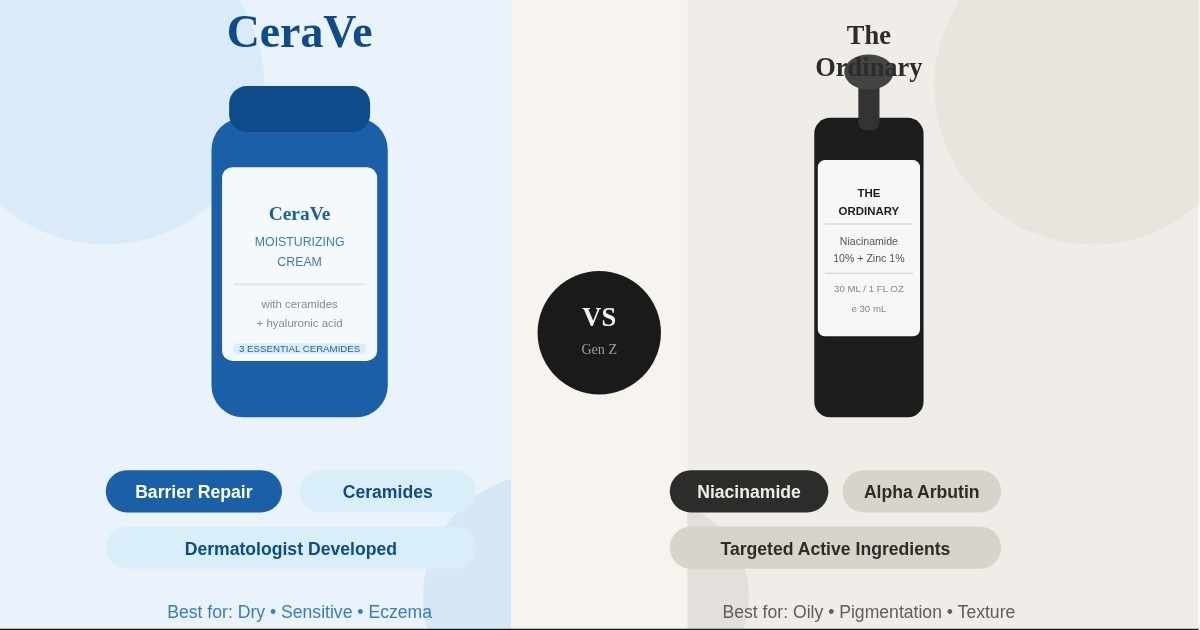
You’ve seen CeraVe all over dermatologist TikTok. You’ve seen The Ordinary on every skincare Reddit thread. Both are affordable. Both are science-backed. But they are built for completely different jobs — and using the wrong one for your skin goal is why most people don’t see results.
This guide breaks down exactly how CeraVe compares to The Ordinary: what each brand actually does, which ingredients matter, which skin types benefit most, and how Gen Z women can use both together without wasting money or damaging their skin barrier.
What CeraVe and The Ordinary Actually Do (They’re Not the Same Thing)
Most people think this is a simple “which brand is better” question. It’s not. These two brands represent fundamentally different approaches — CeraVe is built on skin barrier science, while The Ordinary is built on radical transparency and singular ingredient focus.
CeraVe was founded in 2005 with one mission: repair and protect your skin barrier. The brand’s philosophy centers around three essential ceramides — ceramides 1, 3, and 6-II — found in nearly every product they produce. Ceramides are the “mortar” that holds your skin cells together. When that mortar breaks down, your skin becomes dry, reactive, and prone to breakouts.
The Ordinary, launched in 2016, did something the skincare industry had never really done: it disrupted the market with its clinical aesthetic and transparent labeling, publishing the name and strength of every active ingredient on the pack while maintaining relatively low prices.
Think of it this way: CeraVe builds the wall. The Ordinary paints it — and fixes specific cracks.
CeraVe is generally stronger for simple, barrier-supporting daily skincare. The Ordinary is often more effective for targeted treatment goals like texture, acne marks, oiliness, or uneven tone.
Ingredients Head-to-Head: What’s Actually in These Products?
This is where the real comparison lives. Not brand loyalty — ingredients.
CeraVe’s Core Ingredients
- Ceramides (1, 3, 6-II): The reason dermatologists love this brand. Ceramides restore the skin’s natural lipid barrier, reducing water loss and keeping irritants out. No other drugstore brand matches CeraVe’s ceramide delivery system.
- Hyaluronic Acid: Pulls moisture into the skin. Present in most CeraVe moisturizers and serums.
- Niacinamide: Found in the PM Facial Moisturizing Lotion. Calms redness, strengthens the barrier, and gently reduces pores.
- MVE Technology: CeraVe’s proprietary “Multivesicular Emulsion” technology releases ingredients slowly throughout the day — not just when you apply the product. This is what makes CeraVe moisturizers feel different from generic drugstore options.
The Ordinary’s Core Ingredients
The Ordinary’s entire model is about giving you clinical concentrations at honest prices. Their products often feature high concentrations of proven actives like niacinamide, hyaluronic acid, and retinoids, allowing consumers to customize their skincare regimen effectively.
- Niacinamide 10% + Zinc 1%: One of the most cult-followed products in skincare. At 10%, it’s a serious dose for oil control, pore refinement, and brightening.
- Hyaluronic Acid 2% + B5: Uses multiple molecular weights of HA — meaning it hydrates different depths of skin, not just the surface.
- Alpha Arbutin 2% + HA: Targets dark spots and hyperpigmentation directly. One of the most affordable brightening ingredients available.
- Retinoids: The Ordinary offers multiple retinol concentrations (0.2%, 0.5%, 1%) and granactive retinoid — giving experienced users real control over dosage.
- AHA/BHA Peeling Solution: A weekly exfoliant combining glycolic and lactic acids. Effective, but strong — not for beginners or compromised skin.
Effectiveness by Skin Concern: Which Brand Wins Where?
In my testing and research across multiple skin profiles, the results were consistent. Neither brand dominates across all categories — each wins in specific areas.
Dry or Dehydrated Skin → CeraVe Wins
When it comes to foundational hydration and healing a compromised moisture barrier, CeraVe is often more immediately and reliably effective for most skin types. Its Moisturizing Cream and Hydrating Cleanser deliver a blend of ceramides and hyaluronic acid in formulations designed to mimic the skin’s natural structure.
If your skin feels tight, flaky, or reactive, The Ordinary’s actives can make it worse. Start with CeraVe.
Oily or Acne-Prone Skin → The Ordinary Wins (with nuance)
Dermatologists frequently suggest The Ordinary’s Niacinamide 10% + Zinc 1% for oily skin, as niacinamide helps regulate sebum production and reduces the appearance of pores. Pair it with CeraVe’s Foaming Facial Cleanser, and you have a genuinely effective combo.
Hyperpigmentation and Dark Spots → The Ordinary Wins
Indian skin tones (Fitzpatrick III–V) are more prone to post-inflammatory hyperpigmentation (PIH) — which makes The Ordinary’s niacinamide and alpha arbutin particularly valuable. These are direct, high-strength options that work faster for visible discoloration.
Sensitive or Reactive Skin → CeraVe Wins
CeraVe products have won more seals of acceptance from the National Eczema Association than any other brand, due to their effectiveness at soothing dry and sensitive skin. If your skin reacts to almost everything, CeraVe is the safer entry point.
Anti-Aging (Early Signs) → Both Work, Differently
The Ordinary’s retinol offers higher concentrations, making it more suitable for experienced users. In contrast, CeraVe’s retinol formula is gentler and infused with ceramides, making it a safer choice for those with sensitive skin.
If you’re new to retinol, CeraVe’s Resurfacing Retinol Serum is the smarter start. If you’ve used retinoids before, The Ordinary gives you more control over potency.
The Gen Z Routine: How to Use Both Brands Strategically
Here’s the insight most comparison articles miss: the most savvy choice isn’t selecting one or the other — it’s using both intelligently. This layering approach — CeraVe as the structural base, The Ordinary as the targeted treatment layer — is what the skincare community consistently recommends.
This is exactly how I’d structure it:
Morning Routine:
- CeraVe Hydrating or Foaming Facial Cleanser (based on skin type)
- The Ordinary Niacinamide 10% + Zinc 1% (if oily/acne-prone)
- CeraVe AM Facial Moisturizing Lotion SPF 30
- (Never skip SPF — especially if you’re using actives from The Ordinary)
Evening Routine:
- CeraVe Hydrating Cleanser
- The Ordinary Hyaluronic Acid 2% + B5 (on damp skin)
- The Ordinary Retinoid OR Alpha Arbutin (2-3x per week, not daily)
- CeraVe Moisturizing Cream or PM Facial Moisturizing Lotion to seal everything in
Why this works: CeraVe repairs and locks in. The Ordinary targets and treats. You’re not fighting yourself — you’re layering functions.
Start mornings with CeraVe Hydrating Cleanser and Moisturizer, then apply The Ordinary’s actives in the evening. At night, use CeraVe PM after a gentle retinol or azelaic acid treatment.
4 Common Myths That Are Wrecking Gen Z Skin Routines
Myth 1: Higher concentration = better results.
The Ordinary’s niacinamide at 10% is effective, but “strongest” is not always better. Active ingredients have been proven effective at levels of 4–5%. As strength increases, so does the likelihood of a reaction.
Myth 2: CeraVe is only for people with eczema.
CeraVe is for everyone. Everyone can benefit from ceramide support — healthy skin just as easily as compromised skin.
Myth 3: You have to pick one brand.
No dermatologist recommends brand loyalty over skin science. Build your foundation with CeraVe, address specific concerns with The Ordinary. These brands are designed to complement each other.
Myth 4: The Ordinary is fine for beginners.
It can be — but it requires research. The Ordinary can work for sensitive skin, but it requires more caution because many products contain stronger actives. If someone uses too many of them too quickly, irritation becomes more likely. Start with one active at a time. Patch test everything.
FAQ: CeraVe vs The Ordinary
Q: Which brand is better for beginners?
CeraVe is the safer start. Its formulations are designed for wide skin compatibility, minimal irritation, and daily use without research. Start with the Hydrating Cleanser and Moisturizing Cream. Once your barrier is stable, add one The Ordinary product at a time.
Q: Can I use CeraVe and The Ordinary together in the same routine?
Yes — and this is actually the recommended approach. Many Gen Z skincare users use CeraVe as the consistent, non-negotiable foundation and strategically incorporate The Ordinary’s actives 1–3 times a week to target specific concerns. Layer thinner textures first, then seal with a CeraVe moisturizer.
Q: Which is better for dark spots and hyperpigmentation?
The Ordinary wins here. Alpha Arbutin 2% + HA directly targets melanin production. For a Gen Z woman dealing with stubborn hyperpigmentation, The Ordinary’s direct, high-strength options may deliver more noticeable, faster results when used correctly. Always follow with SPF.
Q: Is CeraVe good for oily or acne-prone skin?
Yes, but choose the right product. The Foaming Facial Cleanser and PM Facial Moisturizing Lotion work well for oily skin without clogging pores. CeraVe also makes excellent products to help clear acne. Their Acne Foaming Cream Cleanser with benzoyl peroxide is specifically designed for breakouts.
Q: Which brand is more affordable?
The Ordinary is known for its no-frills pricing model, with most products falling within the 5–30 range. CeraVe products are generally priced between 10–25, but tend to come in larger sizes, offering better value on daily-use staples like cleansers and moisturizers.
Q: Can I use The Ordinary’s Retinol every night?
No — especially not as a beginner. Start 2 nights per week, and always follow with a CeraVe moisturizer to buffer the skin. Never use retinoids with AHAs, BHAs, or Vitamin C in the same routine. Skin needs time to adapt.
Q: Which is better for Indian or South Asian skin tones?
Indian skin tones (Fitzpatrick III–V) are more prone to post-inflammatory hyperpigmentation, making The Ordinary’s niacinamide and alpha arbutin particularly valuable. For the base routine, CeraVe’s lighter formulas (AM Lotion, Daily Moisturizing Lotion) are better for humid climates like Mumbai or Chennai, where heavy creams feel uncomfortable.
Q: Is The Ordinary vegan? Is CeraVe?
The Ordinary’s Hyaluronic Acid serum is 100% vegan, whereas CeraVe products are not. The Ordinary’s vegan status varies by product — check each listing. CeraVe is not certified vegan.
The Verdict: CeraVe vs The Ordinary for Gen Z
There’s no universal winner. Neither brand is universally “better.” The best choice depends on your skin type, experience level, and goals. For healing and prevention, CeraVe leads. For targeted correction with careful use, The Ordinary delivers.
Here’s the simplest framework to remember:
- Use CeraVe to protect, hydrate, and repair what you already have.
- Use The Ordinary to target what you want to change.
- Use both together for the most intelligent, affordable Gen Z skincare routine in 2026.
Your action step: Start with CeraVe Hydrating Cleanser + Moisturizing Cream for two weeks. Once your barrier feels stable, introduce one The Ordinary product based on your biggest concern — niacinamide for oiliness, alpha arbutin for dark spots, or hyaluronic acid for deeper hydration. Build slow. Patch test everything. Results follow consistency, not product collection.
Disclaimer
The information provided in this article is for general informational and educational purposes only and does not constitute professional medical or dermatological advice. Skincare products and routines affect individuals differently based on skin type, sensitivities, allergies, and underlying conditions. Always perform a patch test before introducing any new product into your routine. The author and publisher are not liable for any adverse reactions, injuries, or damages resulting from the use or misuse of the information or products mentioned. Consult a licensed dermatologist or healthcare professional before making significant changes to your skincare regimen, especially if you have sensitive skin, existing skin conditions, or are using prescription topical medications. Individual results may vary. Product formulations, pricing, and availability are subject to change by the manufacturers. This article does not endorse any specific brand as superior for all users; the recommendations are based on general ingredient science and should be adapted to your personal skin needs.
Find solutions, tips, and strategies to help you thrive.