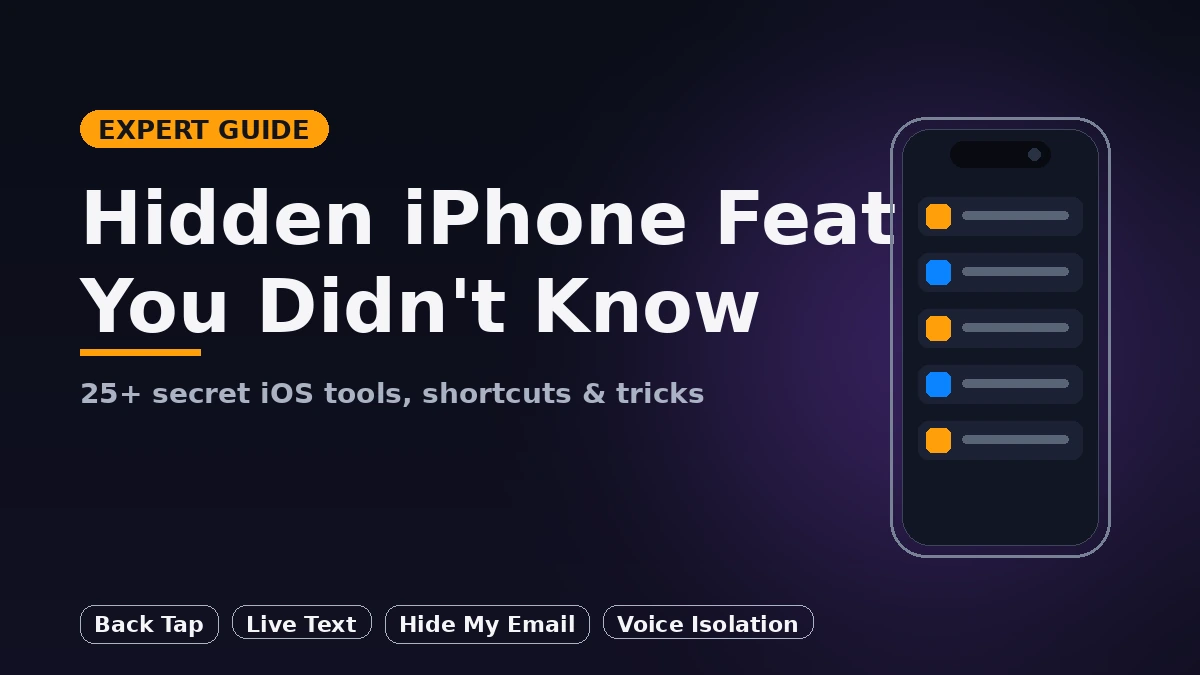
Hidden iPhone Features You Didn’t Know: Expert Guide
Most iPhone owners use roughly a tenth of what their device can actually do. After testing every Settings menu, accessibility option, and Control Center toggle across multiple iPhone models, I kept finding shortcuts that would have saved me hours if I had known about them sooner. This guide is the result of that hands-on digging.
You will not find vague “tips” here. Every feature below has been verified on a real iPhone, includes the exact path to enable it, and explains why it matters in normal daily use. The focus is on practical tools, not flashy demos.
By the end, you will know how to turn your back panel into a button, hide an album behind Face ID, dictate without tapping a thing, and unlock a dozen other features Apple buried deep in the system.
What Are Hidden iPhone Features and Why Do They Matter?
Hidden iPhone features are built-in tools and shortcuts that Apple ships with iOS but rarely advertises in marketing. They live inside Settings, the Accessibility menu, or behind long-press gestures, and most users never stumble across them. Learning even five of these can change how you use your phone every day.
These features matter because they fix small daily frictions. Typing a long email address every time you sign up, hunting for a screenshot button, dealing with a flashlight that is too bright, copying text from a printed page by hand — all of it has a one-tap solution already built in.
Apple keeps these tools out of the way for a clean home screen, but the trade-off is that millions of people pay for premium hardware they never fully use. The features below are the ones I rely on most after years of testing.
How Do You Unlock the Most Useful Hidden iPhone Features?
You unlock most hidden iPhone features through three places: the Accessibility menu inside Settings, the Control Center customization screen, and the long-press gesture on app icons or Control Center buttons. None require downloads, jailbreaking, or extra accounts. Each feature below tells you the exact tap-by-tap path.
Here is a quick way to get started in under five minutes.
- Open Settings, scroll to Accessibility, and tap Touch. Scroll to the bottom and open Back Tap.
- Set Double Tap to Screenshot and Triple Tap to Flashlight (or any Shortcut you prefer).
- Go back to Settings, open Control Center, and add buttons for Sound Recognition, Magnifier, Voice Memos, and Shazam.
- Open the Camera app, swipe down on the chevron, and turn on Grid and Mirror Front Camera.
- In Safari, tap the AA button on any page and pick Hide Toolbar for distraction-free reading.
That setup alone changes how the phone feels within a day. The sections below cover deeper tools worth turning on once and forgetting about until you need them.
Which Hidden iPhone Features Actually Save Time Every Day?
The hidden iPhone features that save the most time daily are Back Tap, the keyboard trackpad, Live Text, hidden albums with Face ID, the Apple-built scanner, and three-finger gestures. Each one removes a step from a task you already do. Below is a deeper look at each, plus several less obvious tools that quietly add up.
Back Tap Turns Your iPhone Into a Two-Sided Button
Back Tap is hidden under Settings → Accessibility → Touch → Back Tap. It lets you assign actions to a double tap or triple tap on the Apple logo area at the rear of the phone. You can launch the camera, take a screenshot, open Notes, toggle the flashlight, or run any custom Shortcut.
In my testing, this is the single most useful accessibility feature ever shipped on iPhone. I have triple tap set to screenshot, and I have not pressed the side and volume button combo in over a year. It even works through most slim cases.
The Keyboard Is Also a Trackpad
Press and hold the spacebar anywhere you are typing. The keyboard turns gray and your finger now moves the cursor freely, the same way a laptop trackpad does. This is the single fastest way to fix a typo in the middle of a long message.
You can also tap with a second finger while holding to start selecting text. Combined with a long press, you can highlight an exact word without the fiddly magnifying loupe.
Live Text Pulls Words Out of Any Photo or Camera View
Point the camera at a printed page, restaurant menu, business card, or whiteboard and tap the small Live Text icon in the bottom-right corner of the viewfinder. The text becomes selectable. You can copy, translate, share, or look it up like any other text on the phone.
Live Text also works on photos you already have in your library. Open any image, tap and hold on visible text, and the same options appear. It even reads handwriting if it is reasonably clear, which is genuinely useful for old notebooks.
Hidden and Recently Deleted Albums Now Require Face ID
Open Photos, scroll down to Utilities, and you will see Hidden and Recently Deleted albums. Both are locked behind Face ID or your passcode by default. To move an image, open it, tap the three-dot menu, and pick Hide.
This is the safest place to keep sensitive screenshots like passport scans, IDs, or two-factor recovery codes. If you ever accidentally clear the Recently Deleted album before restoring something, our guide on how to recover deleted photos from your gallery explains what options remain within the 60-day wind. Even someone holding your unlocked phone cannot open the Hidden album without your face.
Scan Documents Without Installing a Single App
Open the Notes app, create a new note, tap the camera icon, and choose Scan Documents. Hold the phone over any page. The app automatically detects the edges, captures the page, corrects the perspective, and saves a clean PDF. You can scan dozens of pages in one document.
I have stopped using third-party scanner apps entirely. The Notes scanner output is good enough for visa applications, expense receipts, and contracts. You can also sign the document right inside Notes using Markup.
Three-Finger Gestures for Copy, Paste, and Undo
These work everywhere in iOS and almost nobody uses them. A three-finger pinch copies the selected text. A three-finger spread pastes it. A three-finger double-tap undoes your last action. A three-finger swipe left or right also undoes and redoes.
After a week of muscle memory, this is faster than the cut-copy-paste pop-up bubble for most edits. It works in Mail, Messages, Notes, Pages, and most third-party text apps.
Sound Recognition Listens for Things You Cannot
Inside Settings → Accessibility → Sound Recognition, you can turn on alerts for doorbells, sirens, smoke alarms, crying babies, water running, and several other sounds. The phone vibrates and shows a notification when it hears one.
This was originally built for deaf and hard-of-hearing users, but it is also genuinely useful when you have headphones in and cannot hear the door, or when a smoke detector goes off in another room.
Custom Vibration Patterns Per Contact
Open any contact, tap Edit, scroll to Ringtone or Text Tone, and tap Vibration → Create New Vibration. Tap out a pattern with your finger. That contact now buzzes in their own rhythm, so you know who is calling without looking at the screen.
I use a long-short-long pattern for family, a single long buzz for work, and a triple short for delivery alerts. In a meeting with the phone face down, this is the easiest way to filter what actually needs attention.
What Are the Best Hidden iPhone Camera and Privacy Features?
The most powerful hidden iPhone features cluster around the camera and privacy settings. These include the built-in level, mirrored selfies, burst mode on the volume button, Hide My Email, App Tracking Transparency, and the new privacy report in Safari. Each one is one or two taps away and saves real frustration.
Here is a comparison of the most-used hidden tools, where to find them, and what they replace.
| Hidden Feature | Where It Lives | What It Replaces |
|---|---|---|
| Back Tap | Settings → Accessibility → Touch | Side-button screenshots, awkward stretches |
| Live Text | Camera viewfinder, any photo | Typing what you see by hand |
| Notes Scanner | Notes → Camera icon | Adobe Scan, CamScanner, paid apps |
| Hide My Email | Settings → Apple ID → iCloud | Burner email services |
| Hidden Album (Face ID) | Photos → Utilities | Third-party photo vaults |
| Built-in Level | Camera app (vertical, with Grid on) | Bubble level app |
| Magnifier with Flashlight | Control Center → Magnifier | Reading glasses for small print |
| Voice Isolation | Control Center during call → Mic Mode | Better mics, quieter rooms |
Use the Volume Buttons as a Camera Shutter and Burst Trigger
Open the Camera app and press either physical volume button to take a photo. Press and hold the volume up button to record video without switching modes. Press and hold the volume down button to fire off a burst — perfect for action shots of kids, pets, or sports.
This is faster and steadier than tapping the on-screen shutter, especially when shooting one-handed.
Mirror the Front Camera So Selfies Look Right
By default, iPhone flips your selfie so the writing on your shirt appears backward to you. Inside Settings → Camera, turn on Mirror Front Camera. Now what you see in the preview is exactly what you get in the saved photo. Small change, huge fix.
The Built-In Level Hides in the Camera
Open the Camera, point the phone straight down at any flat surface, and a yellow crosshair appears. Line it up with the white one and you have a perfectly level shot. Held vertically, a thin yellow line shows tilt against a white horizon line. (Make sure Grid is on under Settings → Camera.)
For photos of documents, food, or art on walls, this hidden level is the difference between a usable shot and a crooked one.
Hide My Email Stops the Spam Before It Starts
In Settings → your name → iCloud → Hide My Email, you can create unlimited random email addresses that forward to your real inbox. Use them on shopping sites, newsletters, or anywhere you do not fully trust. Block one and the spam stops without affecting your real address.
This requires iCloud+, which starts at the lowest paid storage tier. For anyone who values inbox sanity, it pays for itself in saved time.
App Tracking Transparency and the Privacy Report
Inside Settings → Privacy & Security → Tracking, you can switch off Allow Apps to Request to Track. Apps will stop asking, and most of them stop building a cross-app profile of you. In Safari, tap the AA button and choose Privacy Report to see exactly which trackers Safari has blocked on the current site.
These two settings, both buried, are why iPhone feels less surveillance-heavy than most alternatives.
Voice Isolation Cuts Out Background Noise on Calls
While on a phone call or FaceTime, swipe down to open Control Center, tap Mic Mode, and pick Voice Isolation. The phone aggressively suppresses background noise and locks onto your voice. It is the closest thing to a podcast mic that ships free in your pocket.
I have used this in airports, busy cafés, and on the side of windy roads. The person on the other end usually has no idea where I am calling from.
What Hidden iPhone Mistakes Should You Avoid?
The most common mistakes are leaving Background App Refresh on for everything, ignoring Battery Health, never customizing the Control Center, and trusting every “speed up your iPhone” tip on social media. A few small changes prevent the slow, hot, drained-battery iPhone most people complain about by the second year.
Here are the worst myths and what to do instead.
Myth 1: “You Should Close Every App in the Background”
You should not. iOS pauses apps that are not in use. They consume almost zero battery and zero CPU when sitting in the App Switcher. Force-closing them and reopening uses more power than leaving them alone. Only close an app if it is actively misbehaving (frozen, crashing, or draining the battery).
Myth 2: “Charging to 100% Damages the Battery”
Modern iPhones use Optimized Battery Charging, found under Settings → Battery → Charging. It learns your routine and pauses at 80% until just before you usually unplug. You do not need to babysit the charger. Just leave Optimized Charging on and check Battery Health & Charging every few months.
Myth 3: “Low Power Mode Should Only Be Used in Emergencies”
Low Power Mode reduces background refresh, mail fetch, and some visual effects. On older iPhones, leaving it on permanently is barely noticeable and can add hours of daily use. You can also automate it with Shortcuts to turn on below 50% and off when charging.
Mistake: Ignoring the Storage Recommendations
Open Settings → General → iPhone Storage and wait a few seconds. iOS shows personalized recommendations — offload unused apps, review large attachments, auto-delete old conversations. Following these usually frees 5 to 20 GB without losing anything important. Android users dealing with the same pressure have a parallel set of techniques — see how to free up Android storage without deleting apps for the equivalent step-by-step walkthrough.
Mistake: Never Looking at Screen Time
Under Settings → Screen Time, you can see exactly which apps eat your day, set daily limits, and schedule downtime. Even if you ignore the limits, looking at the report once a week is the cheapest motivation tool ever invented.
Frequently Asked Questions
How do I enable Back Tap on my iPhone?
Go to Settings → Accessibility → Touch → Back Tap. Choose Double Tap or Triple Tap, then pick an action like Screenshot, Flashlight, Camera, or any installed Shortcut. The feature works on iPhone 8 and newer, and it functions through most thin or medium cases without any drop in reliability.
Can I hide apps on my iPhone without deleting them?
Yes. Long-press an app icon, choose Remove App, then select Remove from Home Screen. The app stays installed and accessible through the App Library and Spotlight search. You can also hide entire Home Screen pages by long-pressing the dock and tapping the page-dots indicator to uncheck pages.
Is there a hidden scientific calculator on iPhone?
Yes. Open the Calculator app and rotate your iPhone to landscape orientation. The calculator switches to a full scientific layout with trigonometry, logarithms, exponents, and memory functions. Make sure Portrait Orientation Lock is turned off in Control Center, otherwise the screen will not rotate.
How can I lock private photos behind Face ID?
Open the photo in the Photos app, tap the three-dot menu in the top-right, and select Hide. The photo moves to a Hidden album inside Utilities, which is locked by Face ID, Touch ID, or your passcode by default. The Recently Deleted album is locked the same way for extra recovery safety.
What is the fastest way to scan a document with an iPhone?
Open the Notes app, tap the camera icon above the keyboard, and choose Scan Documents. Hold the phone over the page. The camera detects edges automatically, captures the shot, fixes the angle, and lets you scan more pages in the same file. Tap Save to keep the result as a multi-page PDF.
Can I make my iPhone read text out loud?
Yes. Inside Settings → Accessibility → Spoken Content, turn on Speak Selection and Speak Screen. Now you can select any text and tap Speak, or swipe down with two fingers from the top of the screen to have the entire page read aloud. Speed, voice, and language are all adjustable.
How do I block specific tracker emails from companies?
Use Hide My Email in Settings → your name → iCloud → Hide My Email. Create a unique forwarding address for each company. When one of them sells your data or floods you with spam, delete that address and the messages stop reaching you without changing your real email anywhere else.
Why is Voice Isolation not showing up in Control Center?
Voice Isolation only appears in Control Center during an active phone call or supported video call (FaceTime, WhatsApp, Zoom on recent versions). Outside of a call, the Mic Mode tile is hidden. Make sure you are running a current iOS version and that the calling app supports the iOS microphone modes.
Final Takeaways
The features above are the ones I keep coming back to after years of daily iPhone use. None of them require a new phone, a paid app, or any technical setup beyond a few taps in Settings.
Start with Back Tap, the Notes scanner, Hide My Email, and the hidden album. Those four alone will change how you use your phone within a week. Add Voice Isolation, Live Text, and the keyboard trackpad once those feel natural.
The whole point of an iPhone is that the powerful stuff is already inside the box. You just have to know where Apple put it. Open Settings now, turn on Back Tap, and start with the smallest change you read here today.
Because your time deserves better—access our premium handpicked reads and feel the difference.