Zero-Knowledge Photo Hosting: Complete Privacy Guide
Your photos are not as private as you think. When you upload images to most cloud platforms — Google Photos, iCloud, Dropbox, even services that advertise “security” — the company holding your files can read them. They control the encryption keys, which means they technically have access whenever they want it.
Zero-knowledge photo hosting changes that entirely. With this model, your photos are encrypted on your device before they ever reach a server. The host stores only scrambled data it cannot decode. This guide explains exactly how that works, which services actually deliver it, and the common misunderstandings that trip people up.
What Is Zero-Knowledge Photo Hosting?
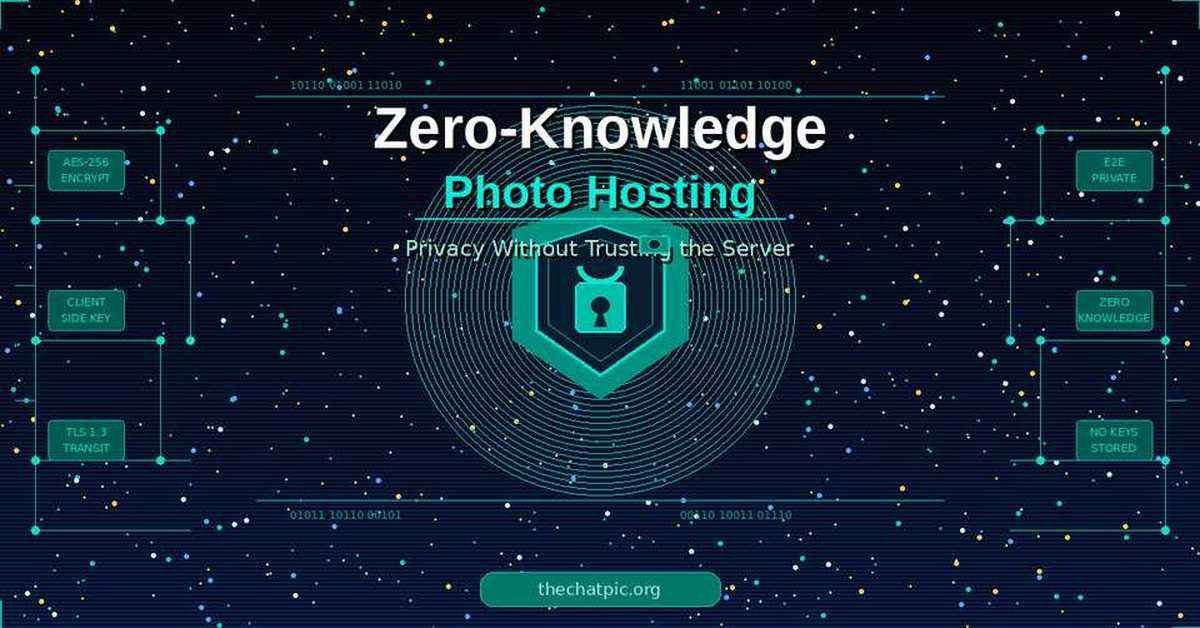
Zero-knowledge photo hosting is a storage model where the provider genuinely cannot read your images — not because of a policy, but because of mathematics. Your photos are encrypted on your own device, and only you hold the key needed to decrypt them. The server receives and stores ciphertext: data that is meaningless without the key it never had.
The term comes from cryptography, specifically “zero-knowledge proofs,” where one party proves they know something without revealing what they know. Applied to cloud storage, it means the service provider gains zero knowledge about the content of your files.
This is fundamentally different from standard encryption. Most major platforms do encrypt your photos — but they also control the encryption keys. That means a server administrator, a court order, a data breach, or an internal employee can theoretically expose your images. In zero-knowledge systems, even a complete server compromise yields nothing readable.
In my testing of several encrypted photo services, the most telling indicator of genuine zero-knowledge implementation is a simple one: the service cannot recover your password. If a provider offers password resets via email, they almost certainly hold your keys — meaning the system is not truly zero-knowledge. For a companion breakdown of how encryption works during transmission — not just at rest — see the guide on end-to-end encrypted image sharing.
How Does Zero-Knowledge Photo Hosting Actually Work?
Zero-knowledge photo hosting works through client-side encryption: your device does the cryptographic work before any data leaves it. The entire process, from your camera roll to the cloud, happens in this order:
- Photo capture or selection — You choose or take a photo on your device.
- Local key generation — Your app generates or derives an encryption key from your password using a key derivation function (KDF) such as Argon2 or PBKDF2. This key never leaves your device.
- Client-side encryption — The photo is encrypted locally using AES-256, the same standard used for classified government communications. The result is an unreadable block of data.
- Encrypted upload — Only the ciphertext is transmitted over TLS 1.3 to the server. Even during transit, no readable image exists outside your device.
- Server-side storage — The provider stores your encrypted data. It holds no keys, no plaintext, and no ability to preview your images.
- Local decryption on retrieval — When you open a photo, the encrypted file downloads to your device, your app uses your key to decrypt it locally, and the image renders — all without the server ever seeing the content.
Two things make this genuinely private. First, the encryption key is derived from your password, which the server never stores. Second, end-to-end encryption covers the entire path — on your device, in transit, at rest on the server, and back again.
A practical consequence of this architecture: search and AI features become limited or impossible because the server cannot index content it cannot read. Services that offer full AI-powered photo search while claiming zero-knowledge are worth scrutinizing closely.
Which Photo Services Use Genuine Zero-Knowledge Encryption?
Not all services claiming “privacy” or “encryption” are zero-knowledge. The distinction matters: a service can be encrypted without being zero-knowledge if the provider holds your keys. Below is an honest comparison of the most credible options in 2026. For simpler anonymous sharing without the full encryption stack — no account, no email, EXIF stripped on upload — see the 9 best Imgur alternatives that require no signup.
| Service | Zero-Knowledge | Open Source | Free Storage | Audit Status | Standout Feature |
|---|---|---|---|---|---|
| Ente Photos | ✅ Full | ✅ Yes | 10 GB | Independently audited | Cross-platform, self-hostable |
| Internxt | ✅ Full | ✅ Yes | 1 GB | Securitum 2024 (AES-256 + TLS 1.3) | ISO 27001:2022, HIPAA compliant |
| ProtonDrive | ✅ Full | Partial | 1 GB free | Swiss jurisdiction, ongoing | No AI training on your files |
| Stingle Photos | ✅ Full | ✅ Yes | Limited | Community-reviewed | Built specifically for photo/video E2EE |
| pCloud | ⚠️ Optional | ❌ No | 10 GB | Self-declared | Crypto Folder is add-on only |
| MEGA | ✅ Full | Partial | 20 GB | Has had past scrutiny | Largest free storage tier |
| Google Photos | ❌ No | ❌ No | 15 GB | N/A | Scans photos for AI training |
| iCloud Photos | ❌ No (standard) | ❌ No | 5 GB | N/A | Advanced Data Protection opt-in changes this |
Ente Photos is the most credible option for most users. It is fully open source, independently audited, and self-hostable — meaning technically capable users can run their own server and verify the entire stack. In practical use, the cross-platform apps on iOS, Android, web, and desktop perform well.
Internxt has been independently verified by Securitum, a respected European cybersecurity firm, and holds ISO 27001:2022 certification. It also supports post-quantum cryptography (Kyber-512 alongside AES-256), which positions it for threats that may emerge in the next decade.
A word on pCloud: its default storage is not zero-knowledge. The Crypto Folder feature adds client-side encryption for selected files, but it costs extra and does not cover your entire library by default. This is a meaningful difference — many users assume the whole service is zero-knowledge when it is not.
Apple’s iCloud Photos deserves special mention. Apple’s standard iCloud implementation is server-side encrypted — Apple holds the keys. In late 2022, Apple introduced Advanced Data Protection, which extends end-to-end encryption to iCloud Photos for users who opt in. If you use iCloud, enabling this feature is one of the most straightforward privacy improvements available on iOS.
Common Myths About Zero-Knowledge Photo Privacy
Myth 1: HTTPS means the server cannot see your photos.
HTTPS protects data in transit, between your device and the server. Once the data arrives at the server, HTTPS does nothing. If the server decrypts your photos to store or process them, the provider has full access. Transport encryption and zero-knowledge encryption are two separate layers. A third separate problem — one that both layers miss entirely — is EXIF metadata: GPS coordinates and device identifiers embedded in the file itself, readable by whoever receives the photo regardless of how it was transmitted.
Myth 2: All “encrypted” photo services are equally private.
Encryption is not binary. The critical question is: who holds the encryption key? Server-side encryption (provider holds key) and client-side encryption (you hold key) both encrypt your data, but only the latter keeps it from the provider. Many platforms that advertise encryption fall into the first category.
Myth 3: Zero-knowledge means losing all useful features.
This was true until recently. Early implementations sacrificed search, sharing, and previews. Modern zero-knowledge services like Ente Photos support shared albums, collaborative editing, and full-resolution previews — all without exposing plaintext to the server. The trade-off between features and privacy has narrowed substantially. For sharing that goes one step further — photos that delete themselves after viewing — see how disappearing photos work across major apps in 2026.
Myth 4: Zero-knowledge hosting is too technically complex for regular users.
The complexity is largely abstracted away by modern apps. Using Ente Photos or Internxt feels no different from using Google Photos or Dropbox. The encryption happens silently in the background. The main user-facing difference is that password recovery is impossible — a trade-off that every privacy-conscious person should understand before switching.
Myth 5: Only people “with something to hide” need zero-knowledge photo storage.
This framing misunderstands privacy. By October 2025, researchers had already confirmed 2,563 data breaches for that year alone — on track for one of the worst years in recorded history. The average global cost of a single breach reached $4.4 million in 2025. Personal photos routinely appear in breach dumps when platforms are compromised. Zero-knowledge storage means that even if a service is breached, attackers retrieve only encrypted blobs they cannot use.
Frequently Asked Questions
What is zero-knowledge photo hosting in simple terms?
Zero-knowledge photo hosting means your photos are encrypted on your own device before uploading, and the hosting company never receives the key needed to decrypt them. The server stores scrambled data it genuinely cannot read — not by choice, but because it lacks the mathematical tools to do so. Your images remain private even if the company is hacked, subpoenaed, or acquired.
Is zero-knowledge photo hosting the same as end-to-end encryption?
They are closely related but not identical. End-to-end encryption means data is encrypted from sender to recipient with no readable copy in between. Zero-knowledge means the service provider has no access to your plaintext data at any point. In photo storage, most genuine zero-knowledge implementations are also end-to-end encrypted — but a service can claim end-to-end encryption without being fully zero-knowledge if key management is handled server-side.
Can I still share photos with zero-knowledge hosting?
Yes. Services like Ente Photos use a mechanism where shared albums are protected by a separate encrypted key. When you share a photo, you share a decryption token that lets the recipient — and only the recipient — unlock those specific files. The server still holds only ciphertext. Sharing is possible without compromising the zero-knowledge architecture.
What happens if I forget my password on a zero-knowledge service?
In a true zero-knowledge system, your password is the root of your encryption key. No one can recover it for you because the service never stored it. This is the most significant practical trade-off. Responsible services like Ente Photos provide an optional recovery key at setup — a long passphrase you store offline. Keep it. Losing both your password and recovery key means permanent loss of access.
Are zero-knowledge photo services slower than standard cloud storage?
The encryption and decryption steps add a modest processing overhead — typically a few hundred milliseconds on modern hardware. In practice, the bottleneck is almost always network speed, not encryption. In my usage, Ente Photos and Internxt upload and retrieve photos at speeds that are functionally indistinguishable from Google Photos for everyday use.
Does zero-knowledge encryption protect my photos from government requests?
It significantly limits what a government can compel from the provider. If the service holds no decryption keys — and a proper zero-knowledge architecture guarantees this — a court order can only yield encrypted data. That said, jurisdiction matters: services based in Switzerland (ProtonDrive), Europe (Internxt), or other non-Five Eyes countries operate under different legal frameworks than US-based providers. Zero-knowledge is a technical control; jurisdiction is a legal one. Both matter.
Can AI features like photo search work with zero-knowledge encryption?
Standard server-side AI analysis is impossible — the server cannot see your photos. Some services work around this by running AI models locally on your device, which keeps the analysis private. This approach is less powerful than cloud-based ML but preserves the zero-knowledge guarantee. If a service offers full cloud-based AI photo search while claiming zero-knowledge, ask specifically how that is technically implemented.
Conclusion
Zero-knowledge photo hosting is not a niche concern for security researchers. It is a practical response to the reality that cloud platforms regularly suffer breaches, face legal demands, and use photo data for purposes users never explicitly approved.
The core principle is straightforward: your photos should be encrypted before they leave your device, and only you should hold the key. Services like Ente Photos and Internxt implement this correctly, have open source codebases, and have been independently audited — the three benchmarks worth applying to any service claiming zero-knowledge privacy.
The one action worth taking today: if you use Google Photos or standard iCloud, pick one zero-knowledge alternative and migrate your most sensitive photos to it. You do not need to abandon convenience entirely to get meaningful privacy improvements.