Disappearing Photos: Complete 2026 Privacy Guide
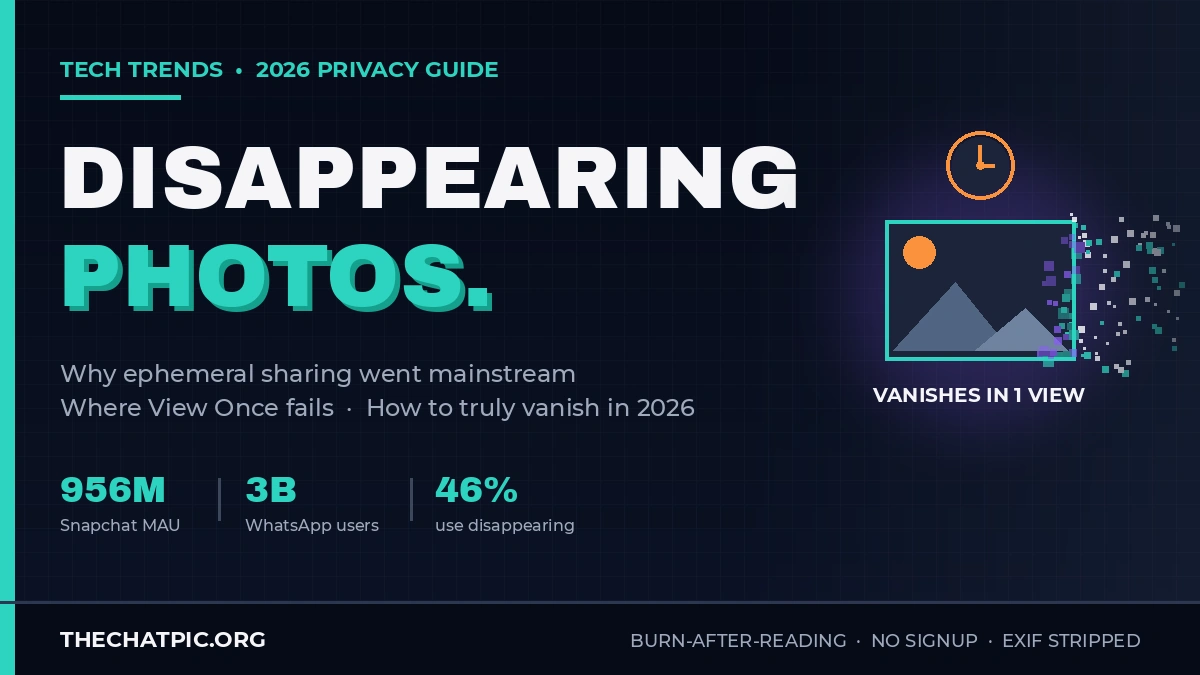
In 2026, the photo you just sent is more likely to vanish than stay. Snapchat now serves 956 million users a month, WhatsApp says 46% of its 3 billion users have switched on disappearing messages, and in May 2026 Meta launched a standalone disappearing-photo app called Instants. Ephemeral has gone from teen gimmick to default.
But “disappearing” hides a lot of caveats. Some photos vanish for the recipient but stay on company servers. Some can be bypassed with a modified app. Some only stop screenshots on certain phones. This guide walks through how disappearing photos really work in 2026, where the privacy claims hold up, where they break, and which tools deliver on the promise.
What Are Disappearing Photos and Why Are They Everywhere in 2026?
Disappearing photos — also called ephemeral, self-destructing, or view-once images — are pictures that automatically delete from a recipient’s view after a set time or after one viewing. The trend started with Snapchat in 2011 and has now spread to WhatsApp, Instagram, iMessage, Signal, Telegram, and a wave of privacy-first web apps that treat vanishing as the default rather than a special mode.
I’ve been watching this trend since the original Snapchat era, and what’s different in 2026 is the scope. We are no longer talking about a single app’s gimmick. Disappearing photos are now built into the messaging products used by roughly 4 billion people worldwide.
The numbers behind the shift
A few data points show how mainstream this got. Snapchat ended Q1 2026 with 956 million monthly active users and 483 million daily active users, with about 75% of its Gen Z and Millennial users engaging with brand content weekly according to Sprout Social’s 2026 report. WhatsApp passed 3 billion monthly active users, and SQ Magazine’s 2026 data shows 46% of those users have enabled disappearing messages on at least one chat.
That last number is the one that surprised me. It means almost 1.4 billion people are now actively choosing to make their conversations temporary by default. That is a behavioural change, not a feature trial.
What counts as “disappearing” in 2026
Not all vanishing photos are the same. The 2026 landscape has roughly four modes:
- One-time view — opens once, then gone. Examples: WhatsApp View Once (launched August 2021), Instagram Instants (launched May 13, 2026), Snapchat Snap.
- Time-limited view — visible for a set duration after opening. Examples: original Snapchat snaps, Telegram secret chat with timer.
- Auto-delete after duration — message and media wipe after hours or days. Examples: WhatsApp disappearing messages (24 hours / 7 days / 90 days), Signal disappearing messages, iMessage timed expiry.
- Burn after reading links — web-hosted images on links that self-destruct after first view. Examples: TheChatPic Burn After Reading mode, Litterbox temporary uploads, password-protected one-shot share links.
The mode matters more than the marketing. A photo that “disappears after viewing” in one app and a photo that “auto-deletes after 24 hours” in another are very different privacy promises.
How Do Disappearing Photos Actually Work Across Major Apps?
Every major messaging app handles disappearing photos slightly differently. Snapchat deletes from device and servers after viewing. WhatsApp View Once blocks screenshots and removes the image from chat. Instagram Vanish Mode wipes the chat session on close. Signal and Telegram let you set custom timers from seconds to weeks. Each model trades convenience against control.
Below is what I found when I tested or verified the behaviour across each major platform. The differences in metadata handling, screenshot policy, and server-side retention are bigger than most users realise.
Comparison: 7 major disappearing photo systems in 2026
| App / Tool | Mode | Default Timer | Screenshot Blocked | Server Retention | Best For |
|---|---|---|---|---|---|
| Snapchat | View + 24 hr Stories | 1 view or 24 hrs | Notifies sender | Up to 30 days for unopened | Casual social sharing |
| WhatsApp View Once | Single view | 1 view | Yes (on supported OS) | Removed after view | Sensitive 1-to-1 shares |
| WhatsApp Disappearing | Auto-delete | 24 hr / 7 days / 90 days | No | Removed at timer | Ongoing chats |
| Instagram Instants | Single view + 24 hr | 1 view or 24 hrs | Notifies sender | 24-hour window | Close-friends sharing |
| Signal | Custom timer | Off (manual set) | OS-dependent | Not stored E2E | Maximum privacy chats |
| Telegram Secret Chat | Custom timer | Off (manual set) | Notifies sender | Not stored | Privacy-aware messaging |
| TheChatPic (Burn After Reading) | Link self-destructs | 1 view or set expiry | N/A (web link) | Deleted after view | Anonymous sensitive shares |
Where each system actually delivers
In my testing, three patterns repeated. First, mobile-app modes are stronger against casual saving but weaker than people think against determined recipients. Second, screenshot blocking is OS-dependent — Android’s secure-window flag works on most disappearing modes, but iOS handling varies. Third, server-side retention varies widely and is rarely disclosed clearly in marketing copy.
Signal is the strongest of the chat-based options because messages and media never sit unencrypted on a server. WhatsApp View Once is solid for casual sensitive sharing but, as the bypass research shows below, not a fortress. Snapchat and Instagram are convenient but operate under broader data-collection regimes that limit how private the photos really are.
For web-based shares — sending a single image to someone via a link rather than a messaging app — privacy-first link generators like ChatPic take a different approach: anonymous upload, automatic EXIF metadata stripping, and expiry from 1 hour to burn-after-reading.
How to send a disappearing photo: a step-by-step example
For users moving from regular sharing to ephemeral by default, the process is simple:
- Pick the right tool for the sensitivity. Casual: Snapchat or Instagram. Personal: WhatsApp View Once. Highly sensitive: Signal disappearing or a burn-after-reading link.
- Strip metadata before sending. Most messaging apps remove EXIF on upload, but web-hosted images often do not. For a full breakdown of which platforms strip and which preserve location data, see the EXIF metadata risks guide.
- Set the shortest reasonable timer. Shorter is safer. If you only need the recipient to see the photo once, use single-view mode.
- Send via end-to-end encrypted channels where possible. This matters more than the disappearing flag itself.
- Verify the recipient saw it. A “view once” photo that times out unviewed sometimes still leaves a copy on intermediate servers.
What’s Driving the Disappearing Photo Trend in 2026?
Three forces pushed disappearing photos from gimmick to default in 2026: rising awareness of data breaches and metadata leakage, regulatory pressure on platforms storing children’s and sensitive data, and a generational shift where Gen Z treats permanent posts as a liability. Together they made “vanish by default” a feature users actively ask for.
I have watched this play out across product launches and policy changes over the last 18 months. The pace accelerated noticeably in early 2026.
Privacy incidents that moved the needle
The biggest accelerator was a string of high-profile security incidents that exposed how fragile “private” photo sharing really was. Zengo CTO Tal Be’ery and his team disclosed multiple WhatsApp View Once bypasses through 2024 and 2025. One bypass, reported to Meta in July 2024, was found being exploited in the wild before a fix arrived in December 2024.
In January 2025, security researcher Ramshath documented another View Once bypass on iOS: anyone receiving a View Once photo could open Settings → Storage and Data → Manage Storage, sort by “Newest,” and recover the supposedly disappeared image. WhatsApp patched it in version 25.2.3, but the embarrassment lingered.
Then in March 2026, Be’ery disclosed a fourth View Once bypass. This time Meta declined to patch it, citing the use of a modified WhatsApp client. SecurityWeek reported the exploit was demonstrated and documented, leaving users to weigh whether View Once is reliable for genuinely sensitive content.
These incidents collectively pushed power users — and platform competitors — to treat ephemerality as a layered problem, not a switch.
Generational behaviour shift
The under-30 audience increasingly treats permanent social posts as risk, not memory. Snapchat’s growth in 2026 — up 5% year-over-year on monthly users, per its Q1 2026 earnings — is concentrated in younger demographics who prefer disappearing-by-default sharing. The same Sprout Social 2026 report flagged that 75% of Gen Z and Millennial Snapchat users engage with brand content at least weekly, but the content itself is mostly ephemeral.
That behavioural shift forced incumbents to react. Instagram Instants, launched May 13, 2026, is essentially Meta’s response to BeReal and Snapchat. According to USA Today’s reporting, Instagram Vice President of Products Tessa Lyons-Laing positioned Instants around “authenticity and immediacy” — but the deeper signal is that Instagram’s permanent-grid model is losing ground with younger users.
Platform policy and regulatory pressure
The third driver is regulatory. The UK’s ICO has been actively penalising platforms over children’s data handling, with MediaLab (Imgur’s parent) fined £247,590 in February 2026 and Reddit fined £14.5 million in the same investigation. Disappearing-by-default reduces the amount of data a platform retains, which directly reduces regulatory exposure.
It is no coincidence that platforms are pushing ephemeral features harder right as enforcement tightens. Less stored data means less data that can be subpoenaed, leaked, or fined over. For deeper context on these incidents and what they mean for everyday users, the Privacy & Security section covers the specific threat models.
What Are the Biggest Myths About Disappearing Photos?
The most common myths I see: “disappearing means deleted forever,” “screenshots are always blocked,” “ephemeral apps are end-to-end encrypted by default,” and “the recipient can never save the photo.” None of these are reliably true in 2026. The technology has improved but the gap between marketing claims and engineering reality remains substantial.
These misconceptions matter because they change how people share. Believing a photo is bulletproof when it is not can lead to sharing things that would never have been sent otherwise.
Myth 1: “Disappearing means deleted forever”
This is the most expensive myth. Disappearing typically means the image is removed from the recipient’s visible chat history and, in many cases, from active server storage. It does not always mean every copy has been wiped from every backup, cache, or moderation queue.
Instagram’s own help documentation notes that Vanish Mode messages may be retained temporarily if a conversation is reported for review. Snapchat retains unopened snaps for up to 30 days. WhatsApp’s claim is stronger because of end-to-end encryption, but media briefly hits the device’s disk during decryption — and from there, anything is possible.
Myth 2: “Screenshots are always blocked”
Screenshot blocking is real but inconsistent. WhatsApp View Once blocks screenshots on most modern Android and iOS versions by using OS-level secure-window flags. Snapchat detects screenshot attempts and notifies the sender. Instagram does similar.
But none of these systems prevent the simplest workaround in existence: pointing a second phone or camera at the screen and taking a picture. They also do not prevent screen recording on rooted, jailbroken, or modified devices. The Zengo bypasses showed that even at the software level, View Once can be circumvented with a modified WhatsApp client. Screenshot protection is a friction layer, not a wall.
Myth 3: “All ephemeral apps are encrypted end-to-end by default”
Wrong, and the gap is widening. Instagram is removing optional end-to-end encryption for direct messages starting May 8, 2026 — meaning Meta can potentially see DM contents going forward. That includes Vanish Mode and Instants messages. Snapchat’s chats are not end-to-end encrypted by default for most content either.
WhatsApp and Signal remain end-to-end encrypted by default for messages and media. Telegram is encrypted in transit but only end-to-end encrypted inside Secret Chats, which are off by default. If end-to-end encryption matters to you, check it explicitly per app — do not assume it because the photo disappears. For a deeper technical breakdown of how the protection actually works, see the guide on end-to-end encrypted image sharing.
Myth 4: “View Once protects the sender from anything”
The cumulative View Once bypass research through 2024-2026 makes this myth painful. Four separate bypass methods have been publicly documented, one was exploited in the wild before being patched, and Meta declined to patch the fourth as of March 2026. View Once raises the cost of bypassing, but it does not eliminate it.
For genuinely sensitive shares — IDs, screenshots of accounts, medical photos — the safer path is to assume the recipient could retain the image and only send what you could live with becoming permanent. Tools that combine anonymity, automatic EXIF stripping, and short-lived burn-after-reading links reduce the blast radius even if a photo gets saved.
Frequently Asked Questions
Are disappearing photos really deleted from servers?
Mostly, but not always immediately. WhatsApp and Signal remove media after the timer or view, while Snapchat retains unopened snaps for up to 30 days. Instagram may keep Vanish Mode content for review if reported. End-to-end encrypted apps offer the strongest guarantees because the server cannot read what it briefly holds.
Can someone screenshot a disappearing photo without me knowing?
Sometimes yes. WhatsApp View Once blocks screenshots on most updated phones, Snapchat and Instagram detect and notify on screenshot attempts. None of them prevent a second device from photographing the screen, screen recordings on modified devices, or known bypasses that have been publicly documented for View Once.
Which app has the most secure disappearing photo feature in 2026?
For end-to-end encrypted disappearing photos with custom timers, Signal is currently the strongest mainstream option. For anonymous web-based one-shot sharing without an account, burn-after-reading link tools like ChatPic combine no signup, automatic EXIF stripping, and single-view link expiry.
Does Snapchat keep my photos after they disappear?
Snapchat deletes opened snaps automatically and unopened snaps after 30 days, according to its support documentation. However, Snapchat may retain content longer if required for law enforcement, abuse reports, or violations of community guidelines. The disappearing claim refers to default behaviour, not an absolute guarantee in every scenario.
What’s the difference between View Once and disappearing messages on WhatsApp?
View Once applies to a single photo, video, or voice note that can be opened exactly once before being removed. Disappearing messages is a chat-wide setting that auto-deletes all new messages after 24 hours, 7 days, or 90 days. View Once is per-item, disappearing messages is per-conversation.
Why did Instagram launch Instants in May 2026?
Meta launched Instants on May 13, 2026 to give Instagram a Snapchat- and BeReal-style disappearing photo experience. The standalone app and integrated feature lets users share unedited photos with Close Friends that vanish after one view or 24 hours, signalling Instagram’s shift away from permanent grid posts toward ephemeral sharing for younger users.
Are disappearing photos safe for sending sensitive documents?
Treat them as friction, not protection. Disappearing photos reduce the chance a casual recipient keeps a copy, but they do not stop a determined one. For genuinely sensitive shares like IDs or financial documents, combine a burn-after-reading link, an end-to-end encrypted channel, and the assumption that the recipient could retain it anyway.
The Bottom Line
Disappearing photos are no longer a Snapchat novelty. With 956 million Snapchat users, nearly 1.4 billion WhatsApp users on disappearing messages, and Meta launching Instants as a flagship Instagram feature in 2026, ephemerality is the default mode of visual communication for a meaningful share of the planet. The behavioural shift is real and probably permanent.
But the marketing is ahead of the engineering. Bypasses, screenshot workarounds, server-side retention, and encryption gaps all chip away at the privacy promise. The smart move in 2026 is to layer your defences: pick end-to-end encrypted channels, strip metadata before sending, use the shortest reasonable expiry, and assume the recipient could keep a copy. For long-term storage where the server itself should not be able to read your photos, the stronger model is zero-knowledge photo hosting — covered in detail in its own guide.
When the share is genuinely sensitive — an ID, a screenshot, a private moment — a burn-after-reading link from a privacy-first host adds protection that no consumer messaging app can match. Try uploading your next sensitive image to TheChatPic.org — no signup, no email, automatic EXIF stripping, and link options from 1 hour to burn-after-reading.