Best Crypto Wallet for Beginners 2026: Expert Guide
Picking your first crypto wallet matters more than picking your first coin. Get the wallet right and a hack, exchange failure, or lost phone is a minor headache. Get it wrong and your savings can vanish with no support team to call. The FTX collapse in 2022 wiped out an estimated $8 billion in customer funds, and recovery is still ongoing in 2026—a reminder of why “not your keys, not your coins” exists.
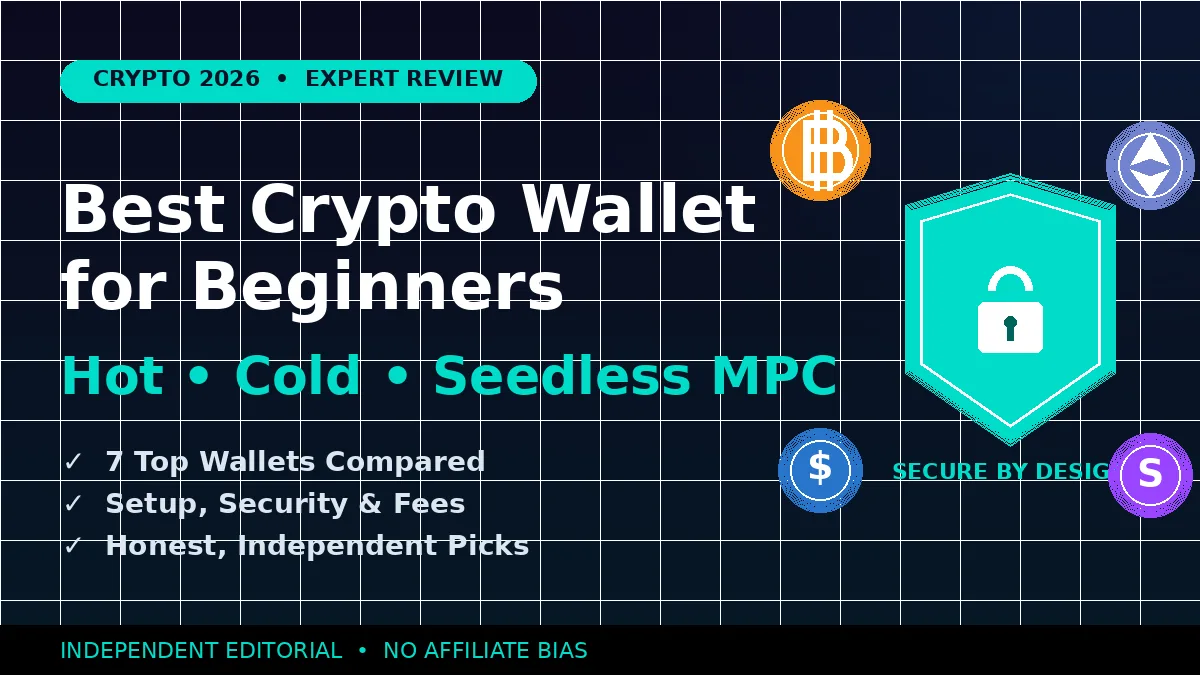
This guide reviews the seven best crypto wallets for beginners in 2026 across three categories—mobile hot wallets, seedless MPC wallets, and hardware cold storage. Each one is tested for ease of setup, fee transparency, recovery options, and asset coverage. By the end, you’ll know exactly which wallet matches your situation and how to set it up safely on the first try.
What’s the Best Crypto Wallet for Beginners in 2026?
The best crypto wallet for beginners in 2026 is Zengo for users who want zero seed-phrase risk, Trust Wallet for the simplest mobile multi-chain setup, and Ledger Nano S Plus for anyone storing more than $1,000 long-term. There is no single winner—the right wallet depends on how much you’re holding, which blockchains you’ll use, and whether you trust yourself to back up a 12-word recovery phrase.
Most first-time buyers make one of two errors: leaving coins on an exchange forever, or jumping straight to a hardware wallet they don’t know how to use. The middle path is a beginner-friendly mobile wallet for small daily amounts, plus a hardware wallet once your portfolio crosses a few hundred dollars.
A quick clarification many guides skip: your crypto doesn’t live “inside” a wallet. It lives on the blockchain. The wallet just stores the private keys that prove you own it. That single fact explains every wallet decision in this article.
How Do Crypto Wallets Actually Work?
A crypto wallet stores the private keys that authorize blockchain transactions. There are three main types: custodial wallets where an exchange holds your keys, non-custodial wallets where you hold your own seed phrase, and MPC wallets where a private key is split into encrypted shards across multiple devices. Each model trades convenience against control.
Understanding these three categories is the single most important thing a beginner can learn before downloading anything.
Custodial Wallets (You Don’t Hold the Keys)
These are the default when you sign up for Coinbase, Kraken, Binance, or any exchange. The platform holds your private keys, and you log in with a password. Pros: familiar comforts like password recovery and customer support. Cons: counterparty risk—if the exchange gets hacked, goes bankrupt, or freezes withdrawals, your crypto is locked.
Non-Custodial Wallets (You Hold the Keys)
Apps like Trust Wallet, MetaMask, and Exodus generate a 12 or 24-word seed phrase you write down. That phrase is your master key. You control everything, and no one can freeze your funds. But there’s no “forgot password” button. Lose the phrase, and your crypto is gone forever. No customer support can help.
MPC Wallets (No Seed Phrase)
Multi-party computation is the 2026 middle ground. Instead of one seed phrase, your private key is split into encrypted shards stored across multiple devices and a backup service. Zengo pioneered the consumer version. The provider can’t unilaterally move your funds because they only hold one shard, but recovery is possible because the shards can be regenerated through biometric login plus a cloud backup.
For beginners especially, MPC removes the single biggest failure point in self-custody: the lost-paper-with-12-words scenario.
What Are the Best Crypto Wallets for Beginners in 2026?
The seven best crypto wallets for beginners in 2026 are Zengo (best seedless MPC), Trust Wallet (best multi-chain mobile), Coinbase Wallet (best for Coinbase users), Exodus (best desktop), Phantom (best for Solana), Ledger Nano S Plus (best hardware under $100), and Tangem (best card-style cold storage). Each excels in a specific use case rather than being universally best.
Here’s how they compare on the things that actually matter for a first wallet.
Comparison: 7 Best Beginner Crypto Wallets (2026)
| Wallet | Type | Seed Phrase? | Fees (Buy) | Best For | Price |
|---|---|---|---|---|---|
| Zengo | MPC hot wallet | No (MPC shards) | ~1.99% bank, ~5.99% card | Beginners avoiding seed risk | Free (Pro $19.99/mo) |
| Trust Wallet | Non-custodial hot | Yes (12 words) | No wallet fee + 3rd-party | Multi-chain mobile users | Free |
| Coinbase Wallet | Non-custodial hot | Yes (12 words) | Coinbase exchange fees | Coinbase users | Free |
| Exodus | Non-custodial hot | Yes (12 words) | ~2–5% built-in swap | Desktop-first users | Free |
| Phantom | Non-custodial hot | Yes (12 words) | ~0.85% swap fee | Solana ecosystem | Free |
| Ledger Nano S Plus | Hardware cold | Yes (24 words) | Network fees only | Long-term holdings over $1K | $79 |
| Tangem | Hardware (NFC card) | No (backup card) | Network fees only | Hardware without seed phrase | $54.90+ |
Now let’s break down what each one is actually like to use.
1. Zengo – Best MPC Wallet for Beginners
Zengo replaces the seed phrase with three encrypted key shards—one on your device, one on Zengo’s servers, one with a trusted recovery party. Setup takes under three minutes using a face scan. You can buy crypto in-app with Apple Pay, Google Pay, or a card.
In my testing, the recovery flow is genuinely the most beginner-friendly of any non-custodial wallet. You can log in to a new phone using your face and email, no paper backup involved. The trade-off is fees: bank transfers cost about 1.99%, while credit card purchases run around 5.99%—higher than buying on Coinbase and transferring. ZenGo’s free tier covers basics; ZenGo Pro is $19.99/month or $199.99 annually with features like advanced theft protection.
Best for: Anyone who has ever lost a sticky note.
2. Trust Wallet – Best Multi-Chain Mobile Wallet
Trust Wallet has crossed 60 million downloads as of 2026 and supports more than 10 million digital assets across 70+ blockchains, including Ethereum, BNB Smart Chain, Bitcoin, Solana, and Polygon. It’s owned by Binance but operates as a self-custody wallet.
The wallet itself charges nothing—the fees you pay are network fees that go to blockchain validators, plus third-party processor fees for in-app buys. Setup gives you a standard 12-word phrase (Classic) or passkey-based recovery (SWIFT version released late 2025). No built-in two-factor authentication, which is the main weakness for a hot wallet holding meaningful value.
Best for: People dabbling in multiple coins on multiple chains.
3. Coinbase Wallet – Best for U.S. Coinbase Customers
This is separate from your Coinbase exchange account—it’s a true non-custodial wallet with your own seed phrase. The big advantage for U.S. users is the seamless flow: buy on Coinbase, withdraw to Coinbase Wallet with a tap, hold long-term.
It supports 10+ blockchains and ships with a browser extension for connecting to DeFi sites. Limitations: it’s still made by a centralized exchange, which makes some crypto purists nervous, and asset coverage is narrower than Trust Wallet’s.
Best for: Beginners who already trust the Coinbase brand and want self-custody without learning a new interface.
4. Exodus – Best Desktop Wallet
Exodus supports more than 250 crypto-assets, runs on Windows, Mac, Linux, iOS, and Android, and includes a built-in swap feature with chat and email support. The interface is closer to a clean budgeting app than a typical crypto wallet.
Two real drawbacks: Exodus is closed source software and does not support two-factor authentication. The built-in swap fees are higher (often 2–5%) than swapping on Uniswap or a centralized exchange. Treat it as a portfolio-tracking convenience rather than a trading platform.
Best for: Beginners who manage their finances on a laptop and want a polished interface.
5. Phantom – Best Wallet for Solana
Phantom was Solana-native but now also supports Ethereum, Polygon, and Bitcoin. The mobile and browser-extension experience is genuinely well-designed—it’s the wallet most Solana power users default to.
If your first buy is SOL, a Solana meme coin, or anything on Solana’s DeFi ecosystem, Phantom is hard to beat. Outside Solana, its features are good but not best-in-class. Some users have reported issues with token values not displaying accurately during periods of high volatility.
Best for: Anyone interested in Solana, Jupiter, or Solana NFTs.
6. Ledger Nano S Plus – Best Beginner Hardware Wallet
For long-term holding, hardware is non-negotiable. The Ledger Nano S Plus runs around $79 and supports thousands of assets via the Ledger Live app. Your private keys never leave the device—they sit inside a CC EAL6+ certified secure element chip used in government-grade systems.
Setup takes roughly 15 minutes: write down 24 words, set a PIN, install asset apps, send a test transaction. Once it’s done, you confirm every outgoing transaction by pressing buttons on the device itself. Even if your computer is infected with malware, the attacker can’t move funds without physical access.
Best for: Any holding above $1,000 you don’t plan to touch for months.
7. Tangem – Best Cold Storage Without a Seed Phrase
Tangem is a hardware wallet that eliminates the need for a seed phrase by using backup cards or rings instead. All key generation and backup processes are protected using end-to-end encryption and a cryptographic chain of trust between its wallet devices. You get two or three NFC cards in a set, tap them against your phone to sign, and keep the backup cards in different physical locations.
It supports 16,000+ cryptocurrencies, including Bitcoin, Ethereum, Solana, Binance Smart Chain, Cardano, Polygon, and Stellar. Pricing starts at $54.90 for a 2-card set and $69.90 for a 3-card set. The Tangem Wallet requires an NFC-enabled smartphone to use the app for managing crypto.
Best for: Beginners who want hardware-level security without a paper backup risk.
How Do You Set Up Your First Crypto Wallet Safely?
To set up your first crypto wallet safely, download only from official sources, write your seed phrase on paper (never digital), store it in two separate physical locations, enable biometric login, send a small test transaction before any large transfer, and never share your seed phrase with anyone—including support staff. Skipping any step is how most beginners lose money.
This is the exact sequence I use when helping someone open their first wallet.
Step-by-Step: Safe Wallet Setup
- Download from the official site only. Type the URL manually—
zengo.com,trustwallet.com,ledger.com. Fake apps in app stores are the most common attack vector in 2026. Check developer name and download count before installing. - Create the wallet and write down the seed phrase on paper. Never screenshot it, never type it into Notes, never save it to iCloud or Google Drive. Pen and paper.
- Store two copies in separate physical locations. One at home, one with family or in a safe deposit box. House fires and burglaries happen.
- Enable biometric login and a strong PIN. Face ID or fingerprint unlock is your first defense if someone grabs your phone.
- Receive a small test transaction first. Send yourself $5 worth of crypto from an exchange. Confirm it arrives. Only then send larger amounts.
- Bookmark your wallet’s official URL. Phishing sites with near-identical names rank in Google ads regularly. Bookmark the real one.
- Never share your seed phrase. Not with a “support agent” on Discord, Telegram, or email. Not with anyone calling you. Real support staff never ask. Period.
If you take only one thing from this guide: a seed phrase typed into any digital device, screenshot, or cloud service has been compromised. Treat that phrase as if it’s $10,000 in cash sitting on your kitchen table.
What Mistakes Do First-Time Wallet Users Make Most Often?
The five most common mistakes first-time crypto wallet users make are: storing seed phrases digitally, using public Wi-Fi during setup, not verifying receiving addresses, falling for fake support scams, and assuming a hardware wallet alone equals safety. Each one is responsible for thousands of cases of permanent fund loss every year.
1. Saving the Seed Phrase to a Cloud Service
It feels safer because cloud accounts have passwords. It’s not. iCloud, Google Drive, Dropbox, and password managers are all targeted constantly. A seed phrase in any cloud account is, in security terms, public.
2. Approving Wallet Connections Without Reading Them
When you connect a wallet to a DeFi app or NFT marketplace, you sometimes grant token approval—permission for that contract to move your funds. Malicious sites trick users into approving infinite withdrawal permissions. Revoke unused approvals monthly at sites like Revoke.cash. The biggest 2026 wallet losses aren’t hacks—they’re scam approvals.
3. Trusting “Customer Support” That Reaches Out First
Real wallet companies do not DM you on Twitter, Discord, Telegram, or Reddit. They do not call you. If someone reaches out claiming to fix your wallet, it’s a scam. 100% of the time.
4. Buying a Used Hardware Wallet
Never buy a Ledger, Trezor, or Tangem from eBay, Amazon Marketplace third-party sellers, or anyone except the manufacturer. Tampered devices have shipped with pre-generated seed phrases the attacker already knows. Buy direct.
5. Not Testing Recovery Before Funding
The terrifying moment is when you lose your phone, find your seed phrase, type it into a new wallet, and learn you misspelled “abandon” three years ago. Practice recovery on a fresh device with a $5 balance before moving real money in.
Frequently Asked Questions
Which crypto wallet is best for absolute beginners?
Zengo is the best wallet for absolute beginners in 2026 because it eliminates seed-phrase risk through MPC technology, lets you buy crypto in-app, and recovers access using face scan plus email. For people who want a more traditional self-custody experience, Trust Wallet and Coinbase Wallet are the easiest starting points.
Is a hot wallet or cold wallet better for beginners?
Hot wallets are better for small amounts and daily use because they’re free, fast, and accessible from a phone. Cold (hardware) wallets are better for amounts you don’t plan to touch for months—typically anything over $1,000. Most experienced users run both: a hot wallet for spending, a hardware wallet for savings.
Are crypto wallets really free?
The wallet apps themselves are usually free. Trust Wallet doesn’t charge fees—the fees you pay are network fees that go to blockchain validators. Trust Wallet keeps $0. Hardware wallets cost $54–$200 one-time. Buying crypto in-app triggers third-party processor fees (typically 1.99% via bank, 5.99% via card).
Can I lose my crypto if the wallet company shuts down?
No, as long as you have your seed phrase or MPC recovery. Non-custodial and MPC wallets only provide the interface—your keys recreate the wallet in any compatible app. If MetaMask vanished tomorrow, you could import the same seed into Trust Wallet, Rabby, or another EVM wallet and your funds would appear instantly.
What’s the safest crypto wallet of 2026?
The safest crypto wallets in 2026 are hardware wallets built around a CC EAL6+ certified secure element chip, such as Ledger signers. Private keys stay offline, and every transaction is verified on a certified secure screen before you approve it. For software-only options, MPC wallets like Zengo lead on security-versus-usability.
Do I need a wallet if I just bought crypto on Coinbase?
Not immediately, but yes if you’re holding long-term. Leaving crypto on an exchange means trusting the exchange. The FTX collapse in 2022 proved that’s a real risk. A self-custody wallet becomes important once you cross a few hundred dollars or plan to hold for more than a few months.
Can one wallet hold Bitcoin, Ethereum, and Solana together?
Yes. Trust Wallet, Exodus, Zengo, and Phantom all support all three. Ledger and Tangem hardware wallets support thousands of assets through their companion apps. MetaMask added Bitcoin and Solana support in 2026, though it remains primarily an Ethereum wallet.
What happens if I forget my wallet password?
For non-custodial wallets, the password only locks the app on your device—your seed phrase recovers access on any new device. For MPC wallets like Zengo, biometric login plus email recovery restores access. For custodial exchange accounts, contact support for a password reset. The seed phrase is the only true “master key.”
Final Take
The best crypto wallet for beginners in 2026 isn’t a single product—it’s the right wallet for your situation. If you’re nervous about losing a paper seed phrase, Zengo’s MPC setup removes that risk entirely. If you want one app for many coins, Trust Wallet is the workhorse. If you’re holding meaningful value long-term, Ledger Nano S Plus at $79 is the cheapest credible hardware option.
A reasonable starter setup: download Zengo or Trust Wallet today for under $200 of crypto exposure — and if you don’t have a bank account, you can still buy your first Bitcoin with cash or a prepaid card. Order a Ledger Nano S Plus once your holdings cross $1,000. Move everything except your spending money to hardware. Practice recovery on a clean device before you ever need it.
Whatever you choose, the rules don’t change: only download from official sites, never digitize your seed phrase, and verify every address with a small test send first. The wallet is just a tool—your habits are what actually keep your crypto safe.
Get motivated by meaningful stories—find fresh angles and inspiring lessons in every read.